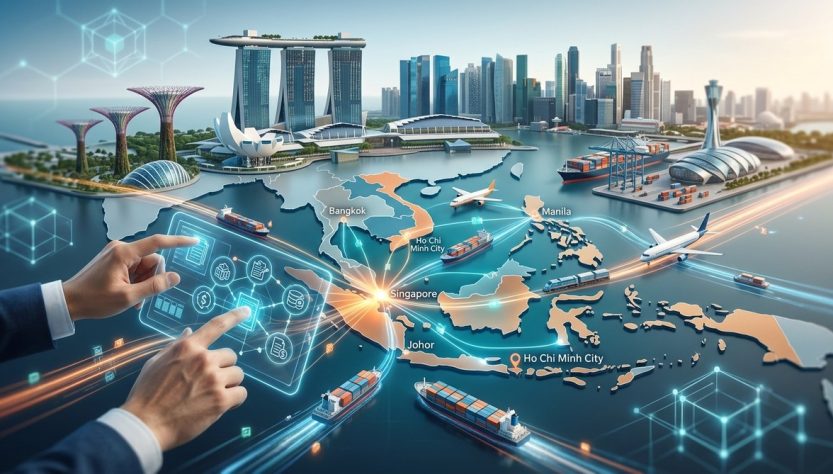
Ask a trade finance manager in Jakarta about their biggest headache. They will not hesitate. It is the waiting. Waiting for paper documents to clear customs, waiting for bank confirmations, waiting for payments to finally land after weeks of uncertainty. Now picture a different world. A trader in Bangkok uploads a digital bill of lading. Within minutes, a smart contract in Singapore verifies it, triggers a letter of credit, and releases funds to a supplier in Ho Chi Minh City. That is not a futuristic dream. That is the reality of Singapore blockchain trade finance in 2026. And it is rewriting the rules of ASEAN commerce.
Singapore has become ASEAN’s hub for blockchain-based trade finance because it combines clear regulation, strong infrastructure, and a network of enterprise consortia. In 2026, these solutions cut transaction times from weeks to hours, reduce fraud by enabling transparent provenance, and lower financing costs for small and medium enterprises across Southeast Asia. This article explains exactly how they work and how your business can benefit.
The Old Trade Finance Game and Why It Is Broken
Trade finance has always been a game of trust and paperwork. Banks rely on letters of credit, bills of lading, and invoices that travel by courier or email. Each step introduces delays, manual checks, and opportunities for fraud. A standard cross border transaction between ASEAN countries can take 10 to 15 days to settle. That is a lifetime when your inventory is stuck at a port and your cash flow is drying up.
The problems multiply when you involve multiple jurisdictions. Different legal systems, varying document standards, and language barriers slow everything down. Small and medium enterprises (SMEs) bear the brunt. Banks often refuse to finance their shipments because verifying their documents is too risky and expensive. As a result, trade in ASEAN remains fragmented, with an estimated 40% of trade finance requests from SMEs rejected according to industry reports from 2025.
Blockchain solves this by creating a single source of truth that all parties can trust. No more reconciling spreadsheets. No more waiting for paper. No more duplicate financing of the same invoice. Singapore recognized this early and built the ecosystem to make it happen.
How Singapore Became the Launchpad for Blockchain Trade Finance
Singapore’s Monetary Authority (MAS) did not just wait for the private sector to figure things out. They actively supported pilot programs, created regulatory sandboxes, and funded research. By 2026, more than a dozen enterprise grade blockchain platforms operate out of Singapore, serving banks, logistics firms, and commodity traders across ASEAN.
What sets Singapore apart is its ability to bring competitors to the same table. Major banks like DBS, OCBC, and UOB now participate in shared blockchain networks for trade finance. They share infrastructure but keep their customer data private. This is possible because of permissioned blockchains where each participant controls their own data while trusting the shared ledger for settlement.
If you want to understand the mechanics better, check out our guide on how distributed ledgers actually work. It walks through the same technology that powers these trade networks.
Key Features of Singapore’s Blockchain Trade Finance Platforms
Here are the core capabilities that make these platforms indispensable in 2026.
- Digital document exchange. Bills of lading, certificates of origin, and invoices are hashed and stored on chain. Any authorized party can verify them instantly.
- Smart contract based letters of credit. Payment triggers automatically when conditions are met, like the arrival of goods at a port.
- Real time financing. Banks can view a seller’s entire trade history on chain, which reduces underwriting risk. SMEs get approved in hours instead of days.
- Regulatory compliance built in. Know Your Customer (KYC) data is shared across institutions using blockchain, cutting duplication and ensuring AML checks are current.
- Interoperability with ASEAN national systems. Platforms connect with Thailand’s National Digital Trade Platform, Indonesia’s trade portals, and Vietnam’s customs systems.
These features are not theoretical. They are live and handling billions of dollars in trade volume every month.
A Step by Step Look at How a Blockchain Trade Finance Transaction Works
Let us trace a real example. A furniture exporter in Vietnam sells to a retailer in Malaysia. Both use a Singapore hosted blockchain platform.
-
Onboarding. The exporter and retailer complete a digital identity verification on the platform. Their KYC data is encrypted and stored on chain. Any bank in the network can access it with permission.
-
Issuing the smart contract. The retailer’s bank in Kuala Lumpur issues a digital letter of credit as a smart contract. It specifies the amount, documents required, and delivery deadlines.
-
Shipping and document upload. The exporter ships the goods. The shipping line uploads a digital bill of lading to the blockchain. Customs authorities in Vietnam and Malaysia can view it simultaneously.
-
Automatic verification and payment. The smart contract checks that all required documents are present and match the terms. Once it confirms, it releases payment from the retailer’s bank to the exporter’s bank. No human intervention needed.
-
Settlement. Funds settle on chain in under 30 minutes. The exporter can then use that same blockchain record to secure a new loan for the next shipment.
The entire process used to take 12 days. Now it takes less than a day. The paperwork cost drops by 70%. And because every step is recorded immutably, disputes are rare.
A Comparison: Traditional vs Blockchain Trade Finance
The table below shows how the two methods stack up in 2026.
| Factor | Traditional Trade Finance | Blockchain Based Trade Finance |
|---|---|---|
| Settlement time | 10 to 15 days | 24 hours or less |
| Documentation cost | $200 to $500 per shipment (paper, courier) | $50 to $100 (digital, automated) |
| Fraud risk | High (duplicate invoices, forged docs) | Low (immutable records, digital signatures) |
| SME accessibility | Low (strict collateral requirements) | High (verifiable trade history on chain) |
| Cross border complexity | Very high (multiple intermediaries) | Low (single shared ledger) |
| Regulatory reporting | Manual, error prone | Automated, real time data to regulators |
The numbers speak for themselves. Businesses that adopt Singapore blockchain trade finance solutions see immediate gains in speed and cost.
Expert Advice on Implementation
“The biggest mistake we see is treating blockchain as a drop in replacement for a database. It is not. You must redesign your workflow around the principle of shared trust. Start with a single pain point, like letters of credit or invoice financing, and expand from there. Singapore’s ecosystem gives you the perfect sandbox to test before scaling across ASEAN.”
Anita Rajan, Head of Digital Trade at a Singapore based fintech consortium
That advice holds true whether you are a bank, a logistics provider, or a trading house. Do not try to boil the ocean. Pick one process, prove the value, then expand.
The Ripple Effect Across ASEAN
Singapore’s blockchain trade finance solutions do not stop at its borders. Thanks to cross border interoperability standards developed with ASEAN partners, a platform hosted in Singapore can connect directly with Thailand’s trade digitalization authority or Indonesia’s national logistics ecosystem. This is a big deal because it means a small manufacturer in Cambodia can access financing from a Singapore bank using verifiable trade data that does not require a brick of paper.
Moreover, Singapore’s regulatory clarity gives comfort to banks in other ASEAN countries. When a bank in the Philippines joins a Singapore based blockchain network, it knows that the legal framework for digital signatures and smart contracts is solid. This reduces the legal risk for everyone involved.
We have a deeper look at this in our article on navigating cross border crypto regulations between Singapore and ASEAN markets. It covers the specific regulatory touchpoints that matter for trade finance.
What Is Next for Singapore Blockchain Trade Finance in 2026
We are now seeing three trends that will shape the rest of the year and beyond.
First, tokenized trade assets. Some platforms are already issuing tokens that represent an invoice or a bill of lading. These tokens can be traded on secondary markets, giving SMEs better liquidity. Instead of waiting 90 days for payment, they can sell the token at a small discount and get cash in hours.
Second, artificial intelligence integration. Smart contracts are being paired with AI to automatically assess risk by analyzing historical trade patterns. This will further reduce the time it takes banks to approve financing.
Third, deeper connections with supply chain finance. The same blockchain that settles a letter of credit can also track the shipment in real time using Internet of Things (IoT) sensors. Buyers can release payment only when the container temperature has remained within acceptable limits, for example.
Singapore is not resting on its laurels. The blockchain trade finance corridor between Singapore, Malaysia, and Thailand is already live, and discussions are underway to include Myanmar and Laos. By the end of 2026, we may see a single ASEAN wide digital trade network powered entirely by distributed ledger technology.
So what does this mean for you? If you work in trade finance or supply chain management, start paying attention now. The tools are available. The regulatory environment is favorable. The cost of inaction is getting higher every month. Reach out to the experts who have already deployed these systems. Ask to see a demo. Run a pilot with a single trade partner. You will be surprised how fast the old way starts to feel outdated.
Remember, the goal is not to adopt blockchain for the sake of it. The goal is to move money and goods across borders with less friction, less risk, and less waiting. That is exactly what Singapore’s blockchain trade finance solutions deliver in 2026. And they are only getting better.