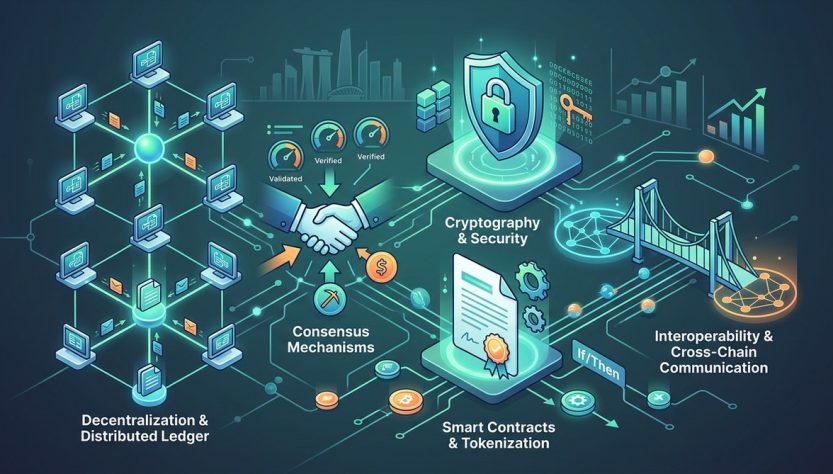
If you’ve heard about blockchain but still feel like it’s a blur of jargon and hype, you’re not alone. Every year brings new terms, upgraded protocols, and shifts in how people actually use this technology. By 2026, blockchain has moved far beyond just powering digital currencies. It’s helping supply chains track goods, letting artists earn royalties without middlemen, and even giving governments a way to issue digital identities. But to really get what’s happening, you need to understand a few core ideas that haven’t changed. These five blockchain concepts are the foundation everything else is built on. Learn them, and you’ll be able to follow any conversation about Web3, finance, or enterprise tech with confidence.
These five concepts form the bedrock of all blockchain applications in 2026. Understanding them helps you separate real innovation from noise. You’ll see how trust is created without a central authority, why smart contracts automate agreements, and how tokens are turning real-world assets into digital ones. Master these, and you’re ready for the next wave of Web3.
The Distributed Ledger: Why Shared Records Create Trust
At its heart, blockchain is a special kind of database. Instead of one company or person controlling the data, many computers (called nodes) each hold a copy of the entire transaction history. Every time something changes, all those copies update together. This is what we call a distributed ledger.
Think of it like a shared Google Doc that a whole class edits. Every student can see the changes in real time. No one can delete a sentence without everyone else noticing. But a distributed ledger goes further: it’s encrypted and uses rules to confirm that every edit is valid.
Here’s why that matters in 2026. Banks, hospitals, and logistics companies are using distributed ledgers to share sensitive data securely. For example, when a shipment of medicine moves from Singapore to Jakarta, customs officers, warehouse managers, and the buyer all see the same record. No one can claim they never received the goods. The ledger becomes the single source of truth.
If you want to see a visual breakdown of how these nodes communicate and verify, check out our guide on how distributed ledgers actually work. It walks through the process step by step.
Consensus Mechanisms: How Everyone Agrees Without a Boss
A distributed ledger is useless if the nodes can’t agree. That’s where consensus mechanisms come in. These are the rules that let all the computers in the network decide together whether a new block of transactions is valid.
In 2026, you’ll hear about proof of stake (PoS) the most. Ethereum switched to it years ago, and most newer blockchains use some variation. Instead of miners solving hard math puzzles (proof of work), validators put up a financial deposit (stake) to earn the right to propose blocks. If they try to cheat, they lose their stake.
But there are other mechanisms too. Delegated proof of stake lets token holders vote for a small group of validators. Proof of authority relies on known, trusted entities. Some networks even mix approaches to get the best balance of speed and security.
This table compares the three most common types you’ll encounter in 2026:
| Mechanism | Who validates | Energy use | Example network |
|---|---|---|---|
| Proof of stake (PoS) | Anyone who stakes tokens | Low | Ethereum, Solana |
| Delegated proof of stake (DPoS) | Elected validators | Low | EOS, TRON |
| Proof of authority (PoA) | Pre-approved validators | Very low | Hyperledger Besu, Binance Smart Chain (old model) |
The key takeaway? Consensus mechanisms are what allow a decentralized network to operate without a central bank or authority. They’re the engine of trust. For a deeper look at why these rules exist, read our explainer on why blockchains need consensus mechanisms.
Smart Contracts: Self-Executing Agreements That Change Everything
A smart contract is a piece of code that lives on the blockchain. It automatically carries out the terms of an agreement when certain conditions are met. No lawyers, no middlemen, no delays.
Picture this: you rent an apartment in New York. The smart contract holds your security deposit in escrow. When you move out and the landlord approves the inspection, the contract instantly releases the deposit back to you. If the landlord doesn’t respond by a set date, the contract returns the money automatically. Everything is transparent and final.
In 2026, smart contracts power much more than rental agreements. They automate insurance claims, execute trades on decentralized exchanges, manage tokenized real estate, and even run entire organizations (DAOs). They’re famously hard to change once deployed, which is both a strength (no cheating) and a risk (bugs are permanent).
Here’s a practical list of what smart contracts can do and what they can’t:
- They can: automatically release payments, transfer digital assets, enforce rules, check external data via oracles.
- They cannot: change themselves after deployment (unless built with upgrade patterns), read off-chain info without oracles, or understand human ambiguity.
If you’re curious about the inner workings, our guide on how smart contracts actually execute on Ethereum Virtual Machine explains the computing model in plain language.
Interoperability: Why Blockchains Must Talk to Each Other
Blockchain used to be isolated islands. Bitcoin did its thing, Ethereum did its thing, and they barely interacted. Today, in 2026, interoperability is one of the most important concepts. It’s what allows one blockchain to send data or value to another.
Why do we need it? Because no single blockchain can do everything well. One chain might be great for payments (fast and cheap), another for complex smart contracts, another for storing huge files. Interoperability lets you use the best tool for each job and still have everything work together.
There are a few ways this happens:
- Cross-chain bridges. These lock tokens on one chain and issue wrapped versions on another. You can use your Bitcoin on Ethereum, for example.
- Layer-zero protocols. Projects like LayerZero and Chainlink CCIP let developers send messages and data directly across chains without a bridge’s middlemen.
- Relays and sidechains. A relay chain acts as a hub, like Polkadot or Cosmos, connecting many specialized chains.
Enterprises love interoperability because it means they can choose a private permissioned ledger for internal use but still connect to public networks for payments or identity verification. For a detailed comparison of public and private architectures, read public vs private blockchains: which architecture fits your business needs?
Tokenization: Turning Anything of Value into a Digital Asset
The fifth concept you need to grasp is tokenization. This is the process of creating a digital token on a blockchain that represents a real-world asset or a right. A token can stand for a share in a company, a piece of art, a barrel of oil, or even a square foot of office space.
In 2026, tokenization has moved from experiment to mainstream. Global banks are tokenizing bonds. Real estate platforms allow you to buy a fraction of a commercial building in downtown Singapore for a few hundred dollars. Even intellectual property like music royalties can be tokenized and traded.
Here’s a step-by-step picture of how tokenization works for a real estate example:
- Asset owner decides to tokenize a property.
- A legal entity (like a trust) holds the title.
- Tokens are created on a blockchain, each representing a fractional ownership share.
- Investors buy tokens, often with stablecoins or fiat currency.
- Smart contracts distribute rental income proportionally to token holders.
- Trading happens on secondary markets, increasing liquidity.
“Tokenization is the killer app for blockchain in enterprise because it unlocks value that was previously illiquid. We’ve seen clients tokenize everything from carbon credits to vintage cars.”
— Sarah Chen, Head of Digital Assets at DLT Singapore
The potential is enormous. According to a 2026 industry report, the total value of tokenized assets globally exceeded $600 billion this year. For a closer look at how traditional businesses are entering this space, see our analysis on real-world asset tokenization.
Putting the Concepts Together: A 2026 Use Case
Let’s combine all five concepts in one real scenario. A coffee company in Vietnam wants to prove its beans are ethically sourced. Here’s the workflow:
- Distributed ledger records every step from farm to roaster.
- Consensus mechanism (proof of authority) ensures only approved auditors and producers can add data.
- Smart contracts release payment to farmers immediately when the shipment arrives at the warehouse.
- Interoperability lets the coffee company’s private ledger share verified data with a public blockchain used by retailers.
- Tokenization turns the carbon offset credits from sustainable farming into tradeable tokens.
This is not science fiction. It’s happening today across Southeast Asia and beyond.
Building a Foundation That Lasts Beyond Hype
These five concepts are your starting point. Distributed ledgers give you a shared truth. Consensus mechanisms build trust without a boss. Smart contracts automate decisions. Interoperability connects worlds. And tokenization unlocks value. Each concept is simple on its own, but together they create something powerful.
The best way to learn is by doing. Pick one concept and read a deeper article, maybe the complete beginner’s guide to cryptographic hashing or what happens when you send a blockchain transaction. Then try a small transaction on a testnet. The technology is built for experimentation. As you build your understanding, you’ll see that blockchain isn’t just a buzzword. It’s a new way to organize trust in a digital world. And you already know the five things that make it work.