A blockchain wallet doesn’t actually store your coins. That sounds strange, right? The coins live on the blockchain itself. Your wallet holds the keys that let you unlock, send, and prove ownership of those coins. Think of it like a keychain for a safety deposit box. The bank holds the box, but you hold the key. If you lose the key, you lose access. If someone copies your key, they take everything. Understanding how these keys work is the single most important step to keeping your crypto safe.
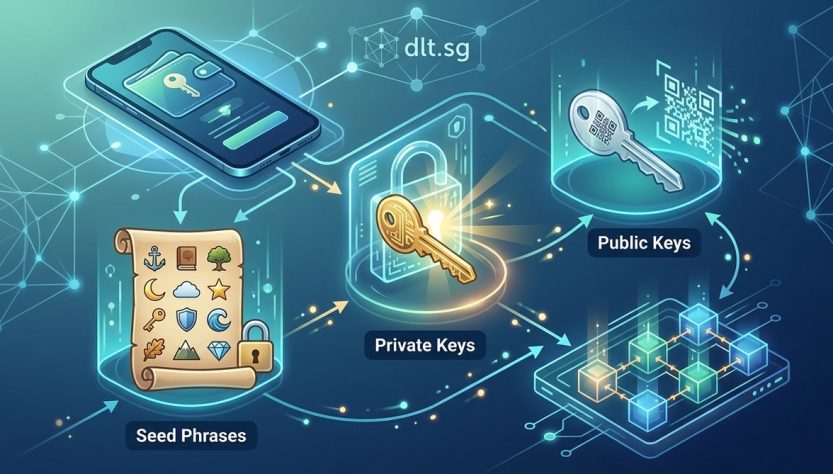
A blockchain wallet is a tool that manages a pair of cryptographic keys: a public key you share freely to receive funds, and a private key you guard like a password to authorize transfers. A seed phrase acts as a master backup for all your keys. If someone gets your private key or seed phrase, they control your assets permanently. Never share them.
What a Blockchain Wallet Actually Is
A blockchain wallet is a software program, hardware device, or even a piece of paper that stores your cryptographic keys. It interacts with the blockchain to check your balance and broadcast transactions. The wallet itself does not hold digital currency. It holds the credentials that prove you own the coins associated with your address.
Most people use a wallet app on their phone or a browser extension. These apps generate the keys for you automatically. When you want to send crypto, the wallet uses your private key to sign the transaction. The network then verifies that signature against your public key. If it matches, the transaction goes through.
This system is called asymmetric cryptography. It is the same technology that secures HTTPS websites and encrypted messaging apps. The difference is that on a blockchain, you are your own bank. There is no customer support line to call if you lose your keys.
Public Keys: Your Digital Address
Your public key is derived from your private key through a one-way mathematical function. You can share your public key with anyone. In fact, that is the whole point. People use it to send you funds.
Most wallets shorten the public key into a wallet address. For Bitcoin, this address is a string of letters and numbers that starts with “1”, “3”, or “bc1”. For Ethereum, it starts with “0x”. You hand this address to someone the same way you would hand them your Venmo username or bank account number.
A few important things to know about public keys:
- They are safe to share on social media, websites, or invoices.
- They do not reveal your private key.
- Each blockchain uses a slightly different format, but the concept is identical.
- You can generate many public keys from a single seed phrase, giving you a new address for every transaction.
Many wallets automatically create a fresh address each time you request one. This improves privacy. It prevents strangers from linking all your payments to a single public key.
Private Keys: The Single Point of Failure
Your private key is a long, randomly generated string of characters. It is mathematically linked to your public key, but you cannot reverse the math to figure out the private key from the public one. That one-way trip is what makes the whole system secure.
If your private key is a password, it is the most important password you will ever own. Unlike a bank password, you cannot reset it. There is no “forgot password” button on a blockchain. If you lose the private key, your coins stay on the ledger forever, unreachable by anyone. If someone steals your private key, they drain your wallet instantly.
Most modern wallets hide the raw private key from you. Instead, they give you a seed phrase.
How a Private Key Works in Practice
- You open your wallet app and choose to send 0.1 Bitcoin.
- The app creates a transaction message that says “send 0.1 BTC from address A to address B.”
- The app signs that message with your private key.
- The signed transaction is broadcast to the network.
- Nodes on the network check the signature using your public key.
- If the signature is valid, the transaction is added to a block.
Without the private key, no one can forge that signature. That is how ownership is enforced on a public, permissionless network.
Seed Phrases: Your Master Backup
A seed phrase is a list of 12, 18, or 24 ordinary words. It is generated by your wallet when you first set it up. This phrase is a human-readable encoding of the master private key. With that phrase, you can restore your entire wallet on any compatible device.
The standard format is called BIP-39. The words come from a fixed list of 2048 English words. Your wallet picks them randomly. The order matters completely. “abandon ability able” is not the same as “able ability abandon.” Even a single wrong word or wrong order produces a different wallet.
Common Mistakes with Seed Phrases
| Mistake | Why It Is Dangerous | Safer Alternative |
|---|---|---|
| Storing the phrase on your phone or computer | Malware or hackers can steal it | Write it on paper and store it in a safe |
| Taking a photo of the phrase | Cloud backups can be breached | Use a metal stamping kit for fire protection |
| Entering the phrase into a website | Phishing sites steal your wallet | Only enter the phrase into the official wallet app during recovery |
| Sharing the phrase with a “support agent” | No legitimate service asks for it | Never share it, period |
Your seed phrase is the master key to your entire crypto portfolio. If you use a hardware wallet like a Ledger or Trezor, the seed phrase is generated offline and never touches the internet. That is the gold standard for security.
Why the Three Pieces Fit Together
The relationship between these three elements is hierarchical.
Your seed phrase generates a master private key. That master private key generates many child private keys. Each child private key has a corresponding public key. Each public key can be hashed into a wallet address.
When you restore a wallet with your seed phrase, the software regenerates every single key and address you ever used. This is why you only need to back up the seed phrase. You do not need to back up individual private keys.
If you want to understand the underlying math at a deeper level, you can read our guide on how distributed ledgers actually work. It covers the cryptographic foundations without getting too technical.
Types of Blockchain Wallets
Not all wallets work the same way. The main categories are:
- Software wallets: Apps on your phone or desktop. Examples include MetaMask, Trust Wallet, and Exodus. They are convenient but vulnerable to malware.
- Hardware wallets: Dedicated devices that sign transactions offline. Examples include Ledger and Trezor. They are much harder to hack.
- Paper wallets: A physical printout of your public and private keys. These are obsolete for most use cases because they are fragile and easy to lose.
- Custodial wallets: Wallets managed by an exchange like Coinbase or Binance. The exchange holds your private key. You control the account through a password, but the exchange controls the crypto.
For any amount you are not actively trading, a hardware wallet or a well-backed-up software wallet is safer than leaving funds on an exchange. Many people learned this lesson the hard way when exchanges collapsed.
How to Set Up Your First Wallet
Setting up a wallet is straightforward. Follow these steps:
- Choose a wallet that matches your needs. For small amounts, a mobile wallet is fine. For larger holdings, buy a hardware wallet from the manufacturer directly.
- Install the software or initialize the hardware device.
- The wallet will display your seed phrase. Write it down on paper. Do not type it into any digital file.
- Store that paper in a safe place. A fireproof safe at home or a safety deposit box works well.
- The wallet will ask you to confirm a few words from the phrase to prove you wrote them down.
- Your wallet is now ready. You will see your public address and can start receiving crypto.
Never take a screenshot of your seed phrase. Never email it to yourself. Never save it in a password manager. The only safe format is physical paper or stamped metal.
What Happens When You Send a Transaction
When you hit “send” in your wallet, a lot happens behind the scenes. The wallet constructs a raw transaction. It includes the inputs (where the funds came from), the outputs (where they are going), and a digital signature. That signature proves you own the private key for the input addresses.
The transaction is then broadcast to the peer-to-peer network. Nodes pick it up and check the signature. If everything is valid, the transaction sits in a pool of unconfirmed transactions called the mempool. Miners or validators select transactions from the mempool to include in the next block.
For a step-by-step walkthrough of this process, see our article on what happens when you send a blockchain transaction. It breaks down each stage from broadcast to final confirmation.
Common Misconceptions About Blockchain Wallets
Many beginners get confused by the terminology. Let me clear up a few myths.
“My wallet holds my coins.”
No. The blockchain holds the coins. Your wallet holds the keys that let you move them.“I need a different wallet for every cryptocurrency.”
Not necessarily. Many wallets support multiple blockchains. MetaMask handles Ethereum and any EVM-compatible chain. Exodus supports dozens of assets.“If I lose my phone, I lose my crypto.”
Only if you did not back up your seed phrase. With the seed phrase, you can restore your wallet on any new device.“Public keys are secret.”
Public keys are meant to be shared. That is why they are called public. Only the private key must stay secret.
For more myths that even tech professionals believe, check out our list of 7 common blockchain misconceptions.
Keeping Your Keys Safe in 2026
Security practices have evolved. In 2026, the biggest threats are not brute force attacks. They are phishing, malware, and social engineering.
Here are the most effective safety measures:
- Use a hardware wallet for anything over a few hundred dollars.
- Never enter your seed phrase into any website, ever.
- Be skeptical of airdrop claims and “connect your wallet” prompts on unknown sites.
- Keep your wallet software updated.
- Consider a multi-signature setup for shared funds or large treasuries.
Multi-signature wallets require more than one private key to authorize a transaction. This is common for businesses and family trusts. It adds a layer of security because a single compromised device is not enough to drain the wallet.
Understanding the Relationship Between Wallets and Nodes
A wallet does not need to run a full node. A full node downloads the entire blockchain and validates every transaction. That requires significant storage and bandwidth. Most wallets are “light clients.” They connect to a node provided by a third party or by the wallet developer.
This is a tradeoff. Light clients are more convenient, but they trust the node to give them accurate data. If the node lies about your balance, your wallet might show incorrect information. Running your own node gives you full sovereignty, but it is overkill for most individual users.
To learn more about the different types of nodes and how they interact with wallets, read our guide on understanding blockchain nodes.
Your Wallet Is Your Responsibility
That is the central truth of self-custody. No bank, no government, and no support agent can reverse a transaction or restore your keys. The freedom of being your own bank comes with the burden of being your own security team.
Start small. Send a tiny test transaction before moving larger amounts. Write down your seed phrase immediately. Double check that you wrote each word correctly. Store that paper somewhere no one else can find it.
Once you have those basics down, you can explore more advanced topics like public vs private blockchains or how enterprise teams use distributed ledger technology for supply chain tracking. But the foundation always comes back to those three pieces: the public key, the private key, and the seed phrase.
Take care of them, and they will take care of your assets. Lose them, and no one can help you. That is the deal. That is the power of blockchain wallets.