
Most enterprise blockchain projects fail not because of the technology, but because nobody decided who gets to decide. When a supply chain consortium debates whether to upgrade the protocol, or a financial network faces a security incident, the absence of clear governance turns a technical question into a political crisis.
A blockchain governance framework defines who makes decisions, how they make them, and what happens when things go wrong. Enterprise implementations need structures that balance decentralization benefits with corporate accountability requirements. Without formal governance, blockchain networks become expensive experiments that collapse under their first real disagreement. The right framework transforms distributed technology into a sustainable business asset.
What Makes Blockchain Governance Different
Traditional IT governance assumes a clear hierarchy. The CIO approves budgets. The security team sets policies. The vendor provides support.
Blockchain breaks that model.
When multiple organizations share a distributed ledger, no single party controls the infrastructure. A bank can’t unilaterally patch the network. A logistics company can’t force a protocol upgrade. A regulator can’t simply demand access to private keys.
This creates three governance challenges that don’t exist in centralized systems.
First, decision rights become ambiguous. Who approves new members joining the network? Who decides when to upgrade smart contracts? Who has authority during a security incident?
Second, accountability becomes distributed. If a bug causes financial loss, who compensates affected parties? If performance degrades, who fixes it? If data gets exposed, who faces regulatory penalties?
Third, incentives become misaligned. One consortium member wants faster transactions. Another prioritizes cost reduction. A third demands stronger privacy. Traditional voting doesn’t work when participants have fundamentally different objectives.
These challenges explain why enterprise blockchain projects often fail despite sound technology. The governance framework you establish before launch determines whether your network thrives or fractures.
Core Components of an Enterprise Blockchain Governance Framework
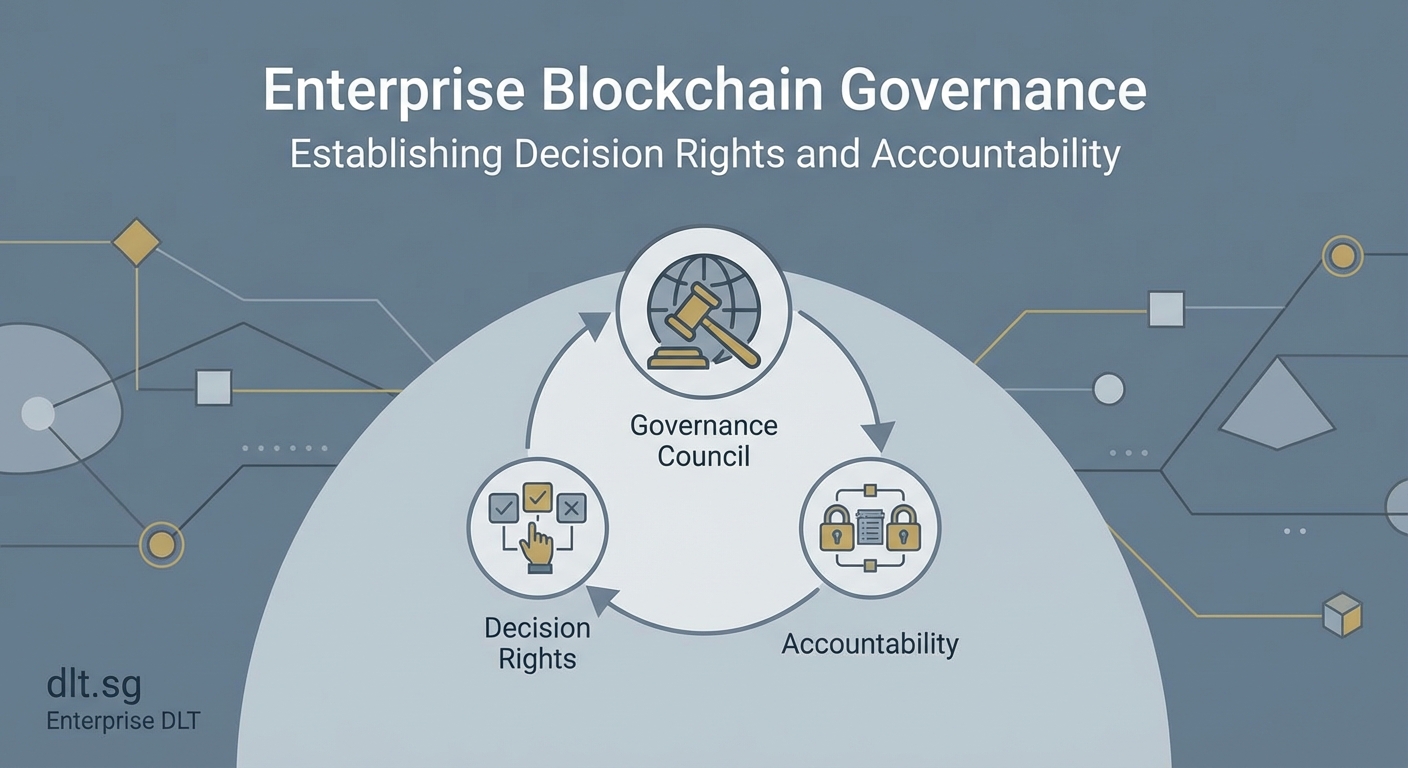
A working governance framework addresses six fundamental questions. Skip any of them and you’ll face conflicts that could have been prevented.
Network membership rules define who can participate and under what conditions. This includes onboarding requirements, exit procedures, and suspension criteria. A trade finance network might require regulatory licenses. A supply chain consortium might mandate insurance coverage. A healthcare blockchain might enforce specific security certifications.
Decision authority structures establish who has power over different types of decisions. Strategic choices like adding new use cases typically require broad consensus. Operational decisions like adjusting gas fees might rest with a technical committee. Emergency responses to security threats often need rapid action from designated parties.
Voting mechanisms translate authority into action. Simple majority voting works for routine matters. Supermajority thresholds protect minority interests on fundamental changes. Weighted voting can reflect financial contribution or transaction volume. Token-based governance introduces market dynamics but creates new manipulation risks.
Technical governance processes determine how the network evolves. Protocol upgrades need testing procedures, rollback plans, and coordination windows. Smart contract modifications require code review, security audits, and versioning strategies. Infrastructure changes demand capacity planning and migration paths.
Dispute resolution procedures handle conflicts before they escalate. Technical disputes might go to an architecture review board. Commercial disagreements could trigger mediation. Violations of network rules need investigation processes and penalty frameworks.
Compliance and audit mechanisms satisfy regulatory requirements while preserving blockchain benefits. This includes determining what data regulators can access, how privacy gets protected, who conducts audits, and how findings get addressed.
The specific implementation varies based on your network architecture and business model. But every framework needs answers to these six areas.
Building Your Framework in Four Phases
Creating an effective blockchain governance framework follows a structured process. Rush it and you’ll miss critical stakeholder concerns. Overengineer it and you’ll never launch.
1. Map stakeholder interests and constraints
Start by identifying every party with decision-making power or veto authority. This includes consortium members, technology providers, regulators, and end users.
Document what each stakeholder cares about most. A bank prioritizes regulatory compliance. A technology vendor wants platform adoption. A logistics company needs operational reliability. A government agency demands transparency.
Identify non-negotiable constraints. Some organizations can’t share certain data types. Others face restrictions on cross-border transactions. Many have internal approval processes that can’t be bypassed.
This stakeholder map reveals where governance conflicts will emerge. Address them in the framework design, not during a crisis.
2. Define decision categories and authority levels
Not all decisions carry equal weight or urgency. Create a decision matrix that categorizes choices by impact and required speed.
| Decision Type | Authority Level | Approval Threshold | Timeline |
|---|---|---|---|
| Strategic direction | All members | 75% supermajority | 30 days |
| Protocol upgrades | Technical committee | Simple majority | 14 days |
| New member admission | Membership committee | 66% supermajority | 7 days |
| Emergency security response | Security officers | Any two officers | Immediate |
| Operational parameters | Operations team | Consensus | 48 hours |
This matrix prevents the common mistake of treating every decision as equally important. Minor operational adjustments don’t need the same process as fundamental protocol changes.
3. Establish committees and assign roles
Governance frameworks need people with clear responsibilities. Most enterprise blockchains benefit from three core committees.
The steering committee sets strategic direction, approves budgets, and resolves major disputes. Members typically include senior executives from each participating organization. They meet quarterly or when major decisions arise.
The technical committee manages protocol evolution, reviews architecture proposals, and coordinates upgrades. Members are blockchain architects and senior developers. They meet monthly and maintain ongoing communication channels.
The operations committee handles day-to-day network management, monitors performance, and addresses routine issues. Members include IT operations staff and network administrators. They maintain 24/7 coverage and meet weekly.
Some networks add specialized committees for compliance, security, or specific use cases. Keep the structure as simple as possible while covering essential functions.
4. Document processes and communication channels
Write down how decisions actually get made. Verbal agreements fail when personnel change or memories fade.
Your governance documentation should include decision workflows, voting procedures, escalation paths, meeting cadences, and communication protocols. Make it specific enough to be actionable but flexible enough to adapt.
Create templates for common processes like proposing protocol changes, requesting new members, or reporting security incidents. Templates reduce friction and ensure consistency.
Establish communication channels that match decision urgency. Strategic discussions might happen in quarterly meetings. Technical coordination could use weekly video calls. Emergency responses need instant messaging and clear phone trees.
“The best governance frameworks are boring. They make routine decisions invisible and reserve energy for choices that actually matter. If you’re constantly voting on trivial matters, your framework has failed.” — Enterprise blockchain architect with 8+ years implementing consortium networks
Common Governance Mistakes and How to Avoid Them
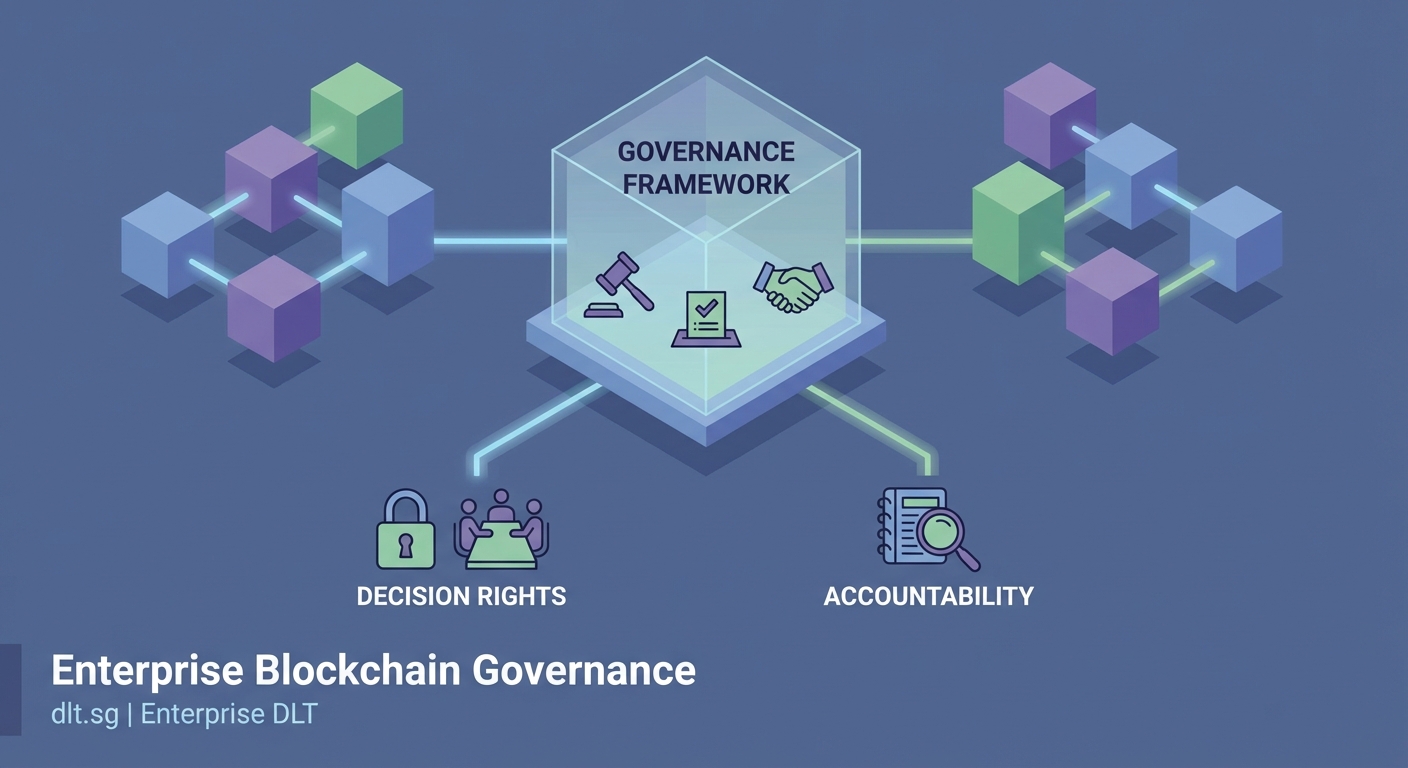
Three governance mistakes appear repeatedly across failed enterprise blockchain projects. Each seems reasonable during design but creates serious problems in operation.
Requiring unanimous consent for routine decisions sounds fair but guarantees gridlock. One absent member blocks a security patch. One holdout prevents a performance optimization. One organization with different priorities vetoes operational improvements.
Fix this by reserving unanimity for truly fundamental changes like dissolving the network or changing the governance framework itself. Use supermajority voting for important decisions and simple majority for routine matters.
Ignoring off-chain governance realities creates a gap between formal rules and actual power. Your governance framework might give equal votes to all members, but if one organization funds 80% of the network, they hold real veto power regardless of voting rules.
Address this by acknowledging power imbalances explicitly. Weight votes by contribution, create special provisions for major funders, or design incentive structures that align interests. Pretending everyone has equal power when they don’t breeds resentment.
Failing to plan for exits assumes the network will last forever with the same members. In reality, organizations get acquired, priorities shift, and business models change. When a founding member wants to leave, unclear exit procedures create chaos.
Build exit processes into your framework from day one. Define how departing members transfer responsibilities, retrieve their data, settle financial obligations, and maintain confidentiality. Make leaving possible without destroying the network.
Governance Patterns for Different Network Types
The right governance structure depends on your network’s purpose and participant relationships. Three common patterns handle most enterprise scenarios.
Consortium governance works when multiple organizations share equal interest in network success. A trade finance network where banks process each other’s transactions. A supply chain where manufacturers, distributors, and retailers track shipments together.
These networks typically use committee structures with representation from each member. Major decisions require supermajority approval. Technical operations might be delegated to a neutral third party or rotated among members.
Anchor tenant governance applies when one large organization invites partners to join their network. A retailer building a supplier blockchain. A manufacturer creating a parts tracking system. A government agency establishing a credential verification network.
The anchor tenant typically retains ultimate authority over strategic direction while giving participants voice in operational matters. This matches the economic reality where one party bears most of the risk and investment.
Operator governance centralizes technical management with a dedicated entity while distributing strategic control. A consortium might hire a neutral operator to run infrastructure while members retain decision authority over business rules and membership.
This pattern works well when participants lack technical expertise or want to avoid operational burden. The operator handles day-to-day management under policies set by member governance bodies.
Many successful networks combine elements from multiple patterns. A consortium might start with anchor tenant governance during launch, then transition to more distributed control as the network matures and members gain experience.
Connecting Governance to Technical Implementation
Governance frameworks only work if they connect to actual network behavior. The gap between governance documents and smart contract execution causes many implementation failures.
On-chain governance mechanisms encode some decisions directly into blockchain protocols. Token holders vote on protocol parameters. Smart contracts automatically execute approved changes. Consensus mechanisms enforce participation rules.
This approach provides transparency and reduces ambiguity. Everyone can verify that governance decisions actually got implemented. Automated enforcement prevents selective rule application.
But on-chain governance has significant limitations for enterprise networks. Not every decision can be encoded in smart contracts. Legal agreements, compliance requirements, and business relationships exist off-chain. Pure on-chain governance often concentrates power among technical participants who understand how to manipulate voting mechanisms.
Off-chain governance handles decisions through traditional organizational processes. Committees meet, members vote, and designated parties implement approved changes. This matches how enterprises actually operate and accommodates legal and regulatory requirements.
The tradeoff is reduced transparency and increased reliance on trust. Members must believe that approved decisions will be implemented correctly. Verification becomes harder.
Hybrid governance combines both approaches. Strategic decisions and membership changes happen off-chain through formal processes. Technical parameters and routine operations get managed on-chain through automated mechanisms. This balances flexibility with transparency.
For example, a trade finance network might use off-chain governance to approve new bank members and set credit policies. But once approved, smart contracts automatically enforce those policies without requiring ongoing manual intervention.
The right balance depends on your regulatory environment, participant sophistication, and network maturity. Early-stage networks often start with more off-chain governance and gradually move appropriate decisions on-chain as the system stabilizes.
Adapting Your Framework as the Network Evolves
Governance frameworks need updating as networks mature. The structure that works for five founding members doesn’t scale to fifty participants. The processes that suit a pilot project become bottlenecks in production.
Plan governance reviews at regular intervals. Annual reviews work for stable networks. Quarterly reviews suit rapidly growing systems. Trigger additional reviews when major changes occur like new use cases, significant membership growth, or regulatory shifts.
During reviews, examine decision velocity. Are approvals taking longer than necessary? Are committees meeting too frequently or not enough? Are escalation procedures getting used appropriately?
Assess participation balance. Do all members engage in governance or have some checked out? Are decisions dominated by a few vocal participants? Do quiet members feel heard?
Evaluate dispute frequency and resolution effectiveness. Repeated conflicts in the same areas signal governance gaps. Long-running disputes indicate inadequate resolution procedures.
Track how governance overhead scales with network growth. If administrative burden increases faster than network value, simplify procedures or automate more decisions.
Document what you learn from governance challenges. When a decision process fails, record why and how you adapted. When a new situation arises that your framework didn’t anticipate, update the framework to handle similar cases better.
The goal isn’t perfect governance from day one. The goal is a framework that improves based on actual experience while maintaining enough stability that participants can rely on it.
Making Governance Work Across Borders and Jurisdictions
Enterprise blockchains often span multiple countries, each with different legal systems and regulatory requirements. This creates governance complexity that domestic networks avoid.
Singapore’s regulatory framework might allow certain data sharing practices that violate European privacy rules. A transaction legal in one jurisdiction could be prohibited in another. Dispute resolution procedures valid in common law countries might not work in civil law systems.
Address jurisdictional complexity through layered governance. Establish a primary legal jurisdiction for the network itself, typically where the operating entity is incorporated. This provides a foundation for contracts and dispute resolution.
Then create jurisdiction-specific governance layers for members operating in different regulatory environments. A European subsidiary might have additional privacy obligations. An Asian member might face different capital controls. A North American participant could have specific audit requirements.
Your governance framework should explicitly state which rules apply globally and which vary by jurisdiction. Global rules cover network-wide matters like protocol standards, membership criteria, and security requirements. Local rules address jurisdiction-specific compliance, reporting, and operational procedures.
Build flexibility for regulatory changes. Governments frequently update blockchain-related regulations. Your framework needs processes for incorporating new requirements without renegotiating the entire governance structure.
Consider regulatory representation in governance bodies. Some networks include legal and compliance experts from each major jurisdiction in their steering committees. Others create dedicated compliance committees that review proposals for regulatory impact before implementation.
The complexity of multi-jurisdictional governance is one reason many enterprises start with private blockchain architectures limited to specific regions. Expanding globally requires governance maturity that takes time to develop.
Measuring Governance Effectiveness
You can’t improve what you don’t measure. Effective governance frameworks include metrics that reveal whether the system actually works.
Track these operational indicators:
- Decision cycle time from proposal to implementation
- Percentage of decisions requiring escalation
- Dispute frequency and resolution duration
- Governance meeting attendance rates
- Time spent on governance versus network operation
- Member satisfaction with governance processes
Monitor these outcome metrics:
- Network uptime and performance stability
- Member retention and new member acquisition
- Transaction volume growth
- Cost per transaction trend
- Security incident frequency and response time
- Regulatory compliance audit results
Compare governance overhead to network value. If you’re spending 30% of total effort on governance for a network processing minimal transactions, your framework is too complex. If governance consumes less than 5% of effort but you face frequent conflicts and slow decisions, you’re underinvesting.
Survey members regularly about governance effectiveness. Ask specific questions like whether they understand how decisions get made, feel their input matters, trust that rules will be enforced fairly, and believe the framework supports network goals.
Pay attention to informal governance signals. Side conversations about changing the framework. Decisions made outside official channels. Members bypassing procedures they find cumbersome. These indicate gaps between formal governance and actual needs.
Use metrics to drive governance improvements, not to create bureaucracy. The goal is a framework that enables network success with minimal friction, not one that generates impressive governance reports.
Why Getting Governance Right Matters More Than Technology
The technical capabilities of blockchain are well understood. Distributed ledgers work. Smart contracts execute reliably. Cryptographic security protects data. The technology isn’t the limiting factor for enterprise adoption.
Governance is.
Most failed enterprise blockchain projects had sound technology but couldn’t navigate the organizational complexity of multi-party collaboration. Founding members disagreed on strategic direction. Technical decisions became political battles. Minor disputes escalated into network-threatening conflicts.
The networks that succeed treat governance as a first-class design concern, not an afterthought. They invest time upfront mapping stakeholder interests, defining decision processes, and building dispute resolution mechanisms. They adapt their frameworks based on experience while maintaining enough stability for participants to rely on.
Your blockchain governance framework determines whether distributed technology becomes a sustainable business asset or an expensive experiment that collapses under its first real disagreement. The investment you make in governance design pays returns every time a decision gets made efficiently, a conflict gets resolved fairly, or a new member joins smoothly.
Start with a simple framework that addresses the six core components. Establish clear decision authority, voting mechanisms, and dispute procedures. Document everything but keep it practical. Review and adapt regularly based on actual experience.
The goal isn’t perfect governance. The goal is a framework good enough to support your network’s growth while bad enough to improve. That combination of stability and adaptability turns blockchain technology into lasting business value.