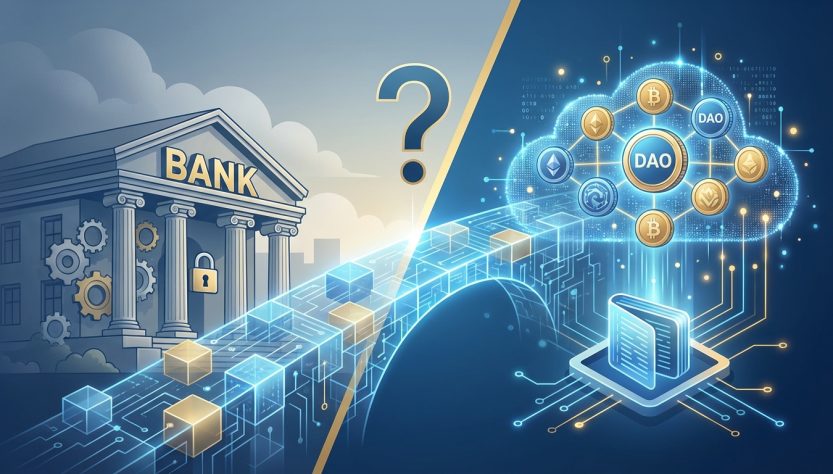
The financial world is splitting into two camps. On one side, traditional banks with centuries of experience, regulatory backing, and trillion-dollar balance sheets. On the other, decentralized protocols running on code, promising to eliminate intermediaries entirely.
The question isn’t just academic anymore. Real money flows through DeFi protocols daily. Billions sit in lending pools. People earn yields that make savings accounts look quaint. Yet most still keep their primary accounts at traditional banks.
DeFi protocols offer compelling advantages in transparency, accessibility, and programmability but face critical challenges in scalability, regulatory uncertainty, and user protection. Rather than complete replacement, a hybrid model where traditional banks integrate blockchain technology while DeFi matures its infrastructure appears most likely. The timeline for any potential displacement extends decades, not years, with coexistence being the near-term reality.
What makes DeFi fundamentally different from traditional banking
Traditional banks operate as trusted intermediaries. You deposit money, they lend it out, everyone trusts the institution to manage the ledger correctly.
DeFi flips this model. Smart contracts replace human decision-makers. Blockchain replaces private databases. Code execution replaces institutional trust.
The difference runs deeper than technology. Banks make subjective credit decisions. They assess your employment history, spending patterns, and social factors. DeFi protocols care only about collateral. Lock up enough crypto assets, borrow against them. No credit check. No loan officer. No waiting period.
This creates both opportunity and limitation. Anyone with internet access can participate. Geographic borders disappear. Banking hours become irrelevant. But the collateral requirement blocks most real-world use cases. Few people can lock up 150% of what they want to borrow.
Understanding how distributed ledgers actually work helps clarify why these protocols function so differently from traditional systems.
Core advantages that DeFi brings to financial services
Several features give DeFi genuine competitive edges over traditional banking infrastructure.
Transparency by default
Every transaction lives on a public blockchain. Anyone can audit the protocol’s reserves, loan portfolio, and risk exposure. No waiting for quarterly reports. No accounting scandals hiding off-balance-sheet liabilities.
Traditional banks operate behind closed doors. Regulators see more than the public, but even they discover problems after the fact. The 2008 financial crisis proved that bank balance sheets can obscure enormous risks.
Programmable money and composability
Smart contracts enable financial products that traditional systems struggle to replicate. Flash loans let you borrow millions for seconds, execute arbitrage, and repay within a single transaction. Automated market makers provide liquidity without order books.
Protocols stack on each other like Lego blocks. One protocol’s output token becomes another’s input collateral. This composability creates financial instruments that banks would need months of legal work and systems integration to launch.
Accessibility without permission
No minimum balance requirements. No account approval process. No geographic restrictions beyond internet access. DeFi protocols serve anyone with a compatible wallet.
This matters most in regions with weak banking infrastructure. Someone in a country with capital controls can access global financial markets. A freelancer without formal employment can earn yield on savings.
The architecture differences between public and private blockchains explain why DeFi prioritizes permissionless access.
Critical limitations preventing full replacement
For all its advantages, DeFi faces structural problems that prevent it from replacing traditional banking today.
The collateral problem kills most lending use cases
Over-collateralization makes DeFi lending useless for most real-world needs. You can’t buy a house by locking up 150% of the purchase price in crypto. Small businesses can’t finance inventory by pledging more than the inventory’s worth.
Traditional banks lend based on future income expectations. They assess your ability to repay from salary, business revenue, or asset appreciation. This enables productive lending that grows the economy.
Some DeFi projects attempt under-collateralized lending through reputation systems or real-world asset tokenization. None have achieved significant scale. The technical and legal complexity remains enormous.
Volatility makes crypto unsuitable as unit of account
Prices denominated in ETH or BTC swing wildly. A loan taken at one valuation might become unpayable after a 40% price drop. Stablecoins solve part of this, but they introduce new dependencies.
Traditional currencies fluctuate too, but within narrower bands. Most people’s income and expenses happen in the same currency. Crypto users constantly face conversion risk and timing decisions.
Smart contract risks create uninsured losses
Code bugs can drain protocols of millions in minutes. No deposit insurance exists. No central authority can reverse fraudulent transactions. Users bear all technical risk.
Banks suffer hacks and fraud too, but deposit insurance protects consumers up to certain limits. Regulatory frameworks provide recourse. DeFi’s “code is law” philosophy means losses are often permanent.
The critical vulnerabilities that auditors look for in smart contracts highlight just how complex security becomes.
Scalability constraints limit transaction throughput
Ethereum processes roughly 15 transactions per second. Visa handles thousands. During peak usage, DeFi transaction fees spike to hundreds of dollars.
Layer 2 solutions and alternative blockchains improve this, but fragment liquidity across multiple networks. Traditional banking infrastructure, for all its legacy technology, handles global transaction volume without users noticing capacity constraints.
How traditional banks are responding to DeFi innovation
Banks aren’t ignoring blockchain technology. Many are selectively adopting elements while maintaining their core business model.
Blockchain for settlement and clearing
Several major banks use distributed ledger technology for interbank settlements. The technology reduces reconciliation costs and settlement times without requiring public blockchain exposure.
This represents incremental improvement, not transformation. The same institutions remain in control. Customers see little difference.
Tokenization of traditional assets
Banks are experimenting with representing bonds, securities, and commodities as blockchain tokens. This could improve liquidity and reduce trading friction.
The approach keeps regulatory compliance and institutional control while gaining some blockchain benefits. It’s blockchain technology without the decentralization philosophy.
Stablecoin issuance and custody services
Major financial institutions now offer crypto custody and are exploring stablecoin products. They position themselves as the safe, regulated on-ramp to digital assets.
This strategy acknowledges crypto’s staying power while capturing fees from customers who want exposure without managing private keys themselves.
What Singapore banks are actually doing with blockchain provides concrete examples of institutional adoption in a progressive regulatory environment.
Regulatory reality shapes the replacement timeline
The question of whether DeFi can replace banks isn’t purely technical. Regulatory frameworks will largely determine the outcome.
Governments won’t abandon financial oversight
No major economy will permit an unregulated parallel financial system to handle significant economic activity. The risks to monetary policy, tax collection, and financial stability are too high.
Regulations are coming. The question is whether they’ll be designed to enable innovation or to protect incumbent institutions. Different jurisdictions are taking different approaches.
Compliance requirements favor established institutions
Banks have compliance departments, legal teams, and regulatory relationships. DeFi protocols have pseudonymous developers and decentralized governance.
As regulations tighten, protocols face a choice. Remain truly decentralized and risk legal action, or incorporate legal entities and lose the decentralization advantage. Many will choose the latter, becoming crypto companies rather than pure DeFi.
Central bank digital currencies enter the picture
CBDCs represent governments creating their own digital currencies. They could combine some blockchain benefits with full regulatory compliance and central bank backing.
If CBDCs succeed, they might capture the “digital money” use case while leaving speculative trading to crypto. This would limit DeFi’s addressable market significantly.
Singapore’s approach to DeFi protocol compliance illustrates how regulators are thinking about oversight without stifling innovation.
Comparing the two systems across key banking functions
| Banking Function | Traditional Banks | DeFi Protocols | Winner |
|---|---|---|---|
| Savings accounts | FDIC insured, low yields | Higher yields, smart contract risk | Depends on risk tolerance |
| Personal loans | Credit-based, reasonable rates | Over-collateralized only | Banks clearly better |
| Business lending | Revenue-based underwriting | Collateral-only or non-existent | Banks by wide margin |
| International transfers | Slow, expensive, limited hours | Fast, 24/7, variable fees | DeFi has edge |
| Payment processing | Established infrastructure, fraud protection | Irreversible, lower fees | Mixed depending on use case |
| Investment products | Regulated, limited options | Permissionless, high risk | Depends on sophistication |
| Customer support | Phone, branch, online help | Community forums, documentation | Banks far ahead |
The hybrid future looks more likely than replacement
Complete replacement assumes a zero-sum game. Reality tends toward integration and coexistence.
Traditional banks adopting DeFi principles
Some banks are building blockchain-based lending platforms that combine smart contract efficiency with traditional credit assessment. This hybrid approach could deliver DeFi’s speed and transparency while maintaining banks’ ability to make under-collateralized loans.
DeFi protocols adding compliance layers
Projects are emerging that add identity verification and regulatory compliance to DeFi protocols. These sacrifice some decentralization to gain legal clarity and broader market access.
Specialized roles for each system
Perhaps traditional banks continue handling everyday transactions, mortgages, and business lending. DeFi focuses on global capital markets, exotic derivatives, and cross-border settlements.
Each system plays to its strengths. Users move between them based on specific needs.
Practical steps to evaluate DeFi for your financial needs
If you’re considering moving some financial activity to DeFi, approach it systematically.
-
Start with a small amount you can afford to lose completely. DeFi carries real risks that insurance won’t cover.
-
Use established protocols with long track records and multiple security audits. Avoid chasing the highest yields from new projects.
-
Understand exactly what happens when you send a blockchain transaction before moving significant value.
-
Keep most savings in traditional banks with deposit insurance. Use DeFi for specific advantages like international transfers or yield farming with risk capital.
-
Track the regulatory environment in your jurisdiction. Rules are changing rapidly and could affect your ability to use certain protocols.
-
Learn about common blockchain misconceptions before assuming DeFi works like traditional finance.
The smartest approach treats DeFi as a complement to traditional banking, not a replacement. Use each system where it performs best, and maintain enough understanding to recognize when one or the other makes more sense for a specific need.
Common mistakes people make when comparing the two systems
-
Assuming all banks are identical: Regional banks, investment banks, and retail banks serve different functions with different strengths and weaknesses.
-
Treating all DeFi as equivalent: A battle-tested lending protocol like Aave differs enormously from a two-week-old yield farm.
-
Ignoring second-order effects: DeFi’s efficiency gains matter less if you lose funds to a smart contract exploit.
-
Overlooking fiat on-ramps: Most people still need to convert between traditional currency and crypto, which requires banks or regulated exchanges.
-
Underestimating user experience gaps: Managing private keys and understanding gas fees creates friction that banks have eliminated.
-
Overestimating regulatory risk for DeFi or underestimating it for banks: Both face regulatory constraints, just different ones.
Why the question itself might be wrong
Asking whether DeFi can replace traditional banks assumes they serve identical functions. They don’t.
Banks provide far more than financial transactions. They’re part of monetary policy implementation. They’re employers. They’re community institutions. They’re regulated entities that governments use to enforce policy.
DeFi protocols are code running on distributed networks. They execute specific financial functions with high efficiency but limited scope.
The better question might be which banking functions are best served by which technology. Some activities benefit from decentralization, transparency, and programmability. Others require human judgment, legal recourse, and regulatory oversight.
Real-world asset tokenization represents one promising middle ground where traditional assets gain blockchain benefits.
Where Southeast Asia fits in this transformation
Singapore and the broader ASEAN region occupy an interesting position in the DeFi versus traditional banking debate.
The region combines sophisticated financial centers with large unbanked populations. This creates opportunities for both systems.
Singapore’s regulatory approach encourages innovation while maintaining oversight. The city-state wants to be a blockchain hub without becoming a haven for financial crime. This balance attracts projects willing to operate within legal frameworks.
Meanwhile, countries like the Philippines and Indonesia have large populations that could benefit from DeFi’s permissionless access. Remittances represent a massive use case where DeFi could reduce costs significantly.
Navigating cross-border crypto regulations becomes critical for projects serving multiple countries in the region.
The timeline for meaningful displacement
If DeFi were to replace significant banking functions, the timeline extends decades, not years.
Near term (2024-2027)
DeFi remains a parallel system serving crypto-native users and specific use cases like international transfers. Traditional banks dominate consumer and business banking.
Regulations tighten. Some protocols shut down or relocate. Others add compliance features and become crypto companies rather than pure DeFi.
Medium term (2028-2035)
Hybrid systems emerge. Banks offer blockchain-based products. DeFi protocols add identity layers. The distinction between the two blurs.
CBDCs launch in major economies, capturing some of DeFi’s digital currency use case. Stablecoins face stricter regulation.
Long term (2036+)
If blockchain technology proves superior for most financial functions, and if regulatory frameworks evolve to permit it, traditional banks might become primarily regulatory entities and customer interfaces built on decentralized infrastructure.
This outcome isn’t guaranteed. Technology doesn’t always displace incumbents. Often it gets absorbed and adapted.
What this means for professionals and investors
Your strategy depends on your role in the financial ecosystem.
For banking professionals
Learn blockchain technology. Your institution will likely adopt elements of it. Understanding the technology helps you identify which functions benefit from decentralization and which don’t.
For investors
Maintain exposure to both traditional finance and crypto assets. The winner might be “both” rather than one replacing the other. Diversification across the two systems reduces risk.
For developers
Building bridges between traditional finance and DeFi creates more immediate value than betting entirely on replacement. Integration projects solve real problems today.
For regulators
The challenge lies in enabling innovation while protecting consumers and maintaining financial stability. Heavy-handed regulation pushes innovation offshore. Too little oversight risks systemic problems.
The real answer to whether DeFi can replace banks
Can DeFi replace traditional banks? Technically, for some functions, yes. Practically, completely, in the near future? No.
The question frames the situation as binary when reality offers more nuance. DeFi excels at specific tasks where transparency, programmability, and permissionless access matter most. Traditional banks excel where human judgment, legal recourse, and regulatory compliance are essential.
The financial system of 2030 will likely include both. Traditional banks will adopt blockchain technology where it improves efficiency. DeFi protocols will add compliance features where regulations require them. Users will move between systems based on specific needs.
Replacement suggests one system dies while another thrives. Evolution seems more likely. Both systems will change significantly, borrowing features from each other, until the distinction becomes less meaningful than the specific financial service being provided.
The transformation is happening. Just not in the simple replacement narrative that makes for compelling headlines. Reality is messier, slower, and ultimately more interesting than a clean substitution of one system for another.
Understanding both systems positions you to benefit regardless of which direction the evolution takes. Stay informed, remain flexible, and use each system where it performs best for your specific needs.