
Building a decentralized application might feel overwhelming when you’re staring at unfamiliar tools and frameworks. But here’s the truth: you already have most of the skills you need. If you can write JavaScript and understand basic programming concepts, you can build a dapp. The learning curve is real, but it’s not as steep as you think.
Building your first dapp requires understanding smart contracts, choosing the right blockchain platform, setting up a development environment, and connecting a frontend to your deployed contract. You’ll work with tools like Hardhat or Truffle, write Solidity code, test on local networks, and integrate Web3 libraries. The process takes days, not months, and you’ll have a working application that runs on blockchain infrastructure.
Understanding What You’re Actually Building
A dapp is just a regular application with one key difference: its backend runs on a blockchain instead of a traditional server.
The frontend looks normal. Users see buttons, forms, and familiar interfaces. But when they click “submit,” that action triggers a smart contract instead of hitting an API endpoint.
Smart contracts are self-executing programs stored on the blockchain. They handle logic, store data, and enforce rules without a central authority. Think of them as backend functions that anyone can verify and no one can manipulate.
Most dapps use this three-layer architecture:
- Smart contracts handle business logic and data storage
- Web3 libraries connect your frontend to the blockchain
- A traditional frontend provides the user interface
You’ll need to understand how distributed ledgers actually work before writing your first contract. The blockchain isn’t just a database. It’s a network of computers maintaining identical copies of data through consensus rules.
Choosing Your Blockchain Platform
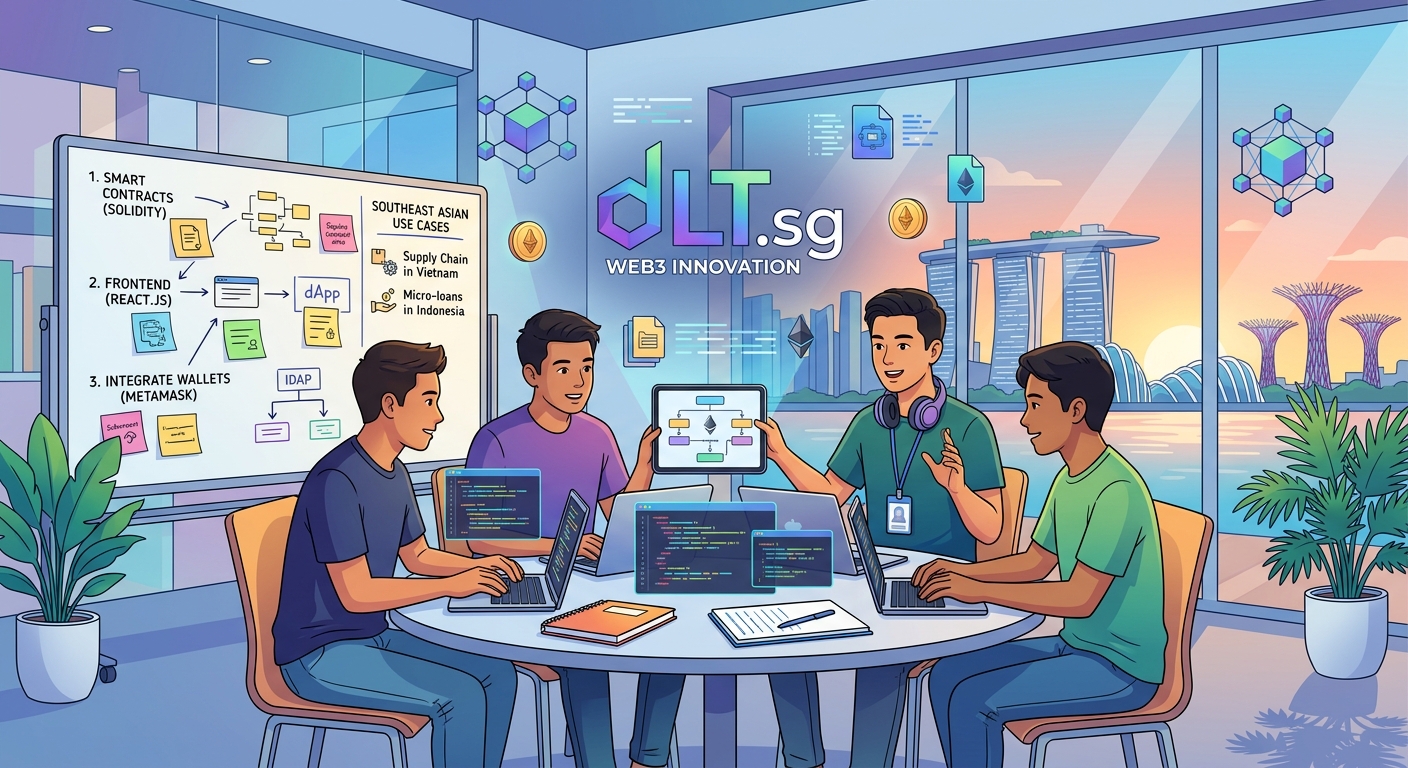
Your platform choice affects everything: development tools, costs, user base, and deployment complexity.
Ethereum remains the most popular choice for beginners. It has extensive documentation, active communities, and mature tooling. Gas fees can be high on mainnet, but testnets are free.
Polygon offers Ethereum compatibility with lower costs. Your Solidity code works the same way, but transactions cost fractions of a cent. Many Southeast Asian projects choose Polygon for this reason.
BNB Chain provides another EVM-compatible option. It’s faster and cheaper than Ethereum mainnet, with strong adoption in Asia.
For enterprise applications, consider public vs private blockchains based on your access requirements and governance needs.
Here’s how the main platforms compare for first projects:
| Platform | Learning Curve | Cost | Documentation | Best For |
|---|---|---|---|---|
| Ethereum | Moderate | High (mainnet) | Excellent | Learning fundamentals |
| Polygon | Low | Very low | Good | Production dapps |
| BNB Chain | Low | Low | Good | Fast deployment |
| Hardhat Network | Very low | Free | Excellent | Local testing |
Start with Ethereum’s testnet. You’ll learn standard tools and patterns that transfer to other platforms.
Setting Up Your Development Environment
You need Node.js installed first. Version 16 or higher works best with current Web3 tools.
Install Hardhat as your development framework:
npm install –save-dev hardhat
Hardhat provides a local blockchain, testing framework, and deployment tools in one package. It’s replaced Truffle as the community standard.
Create a new project:
npx hardhat init
Choose “Create a JavaScript project” when prompted. This generates a basic structure with sample contracts and tests.
Install essential dependencies:
npm install –save-dev @nomicfoundation/hardhat-toolbox
npm install ethers
Ethers.js handles blockchain interactions from your frontend. It’s lighter and more intuitive than Web3.js.
You’ll also need MetaMask installed in your browser. This wallet extension lets you interact with dapps and sign transactions. Set it up with a test account and never use it for real funds.
Writing Your First Smart Contract

Start with something simple. A basic storage contract teaches core concepts without complexity.
Create SimpleStorage.sol in your contracts folder:
“`solidity
// SPDX-License-Identifier: MIT
pragma solidity ^0.8.0;
contract SimpleStorage {
uint256 private storedNumber;
function store(uint256 num) public {
    storedNumber = num;
}

function retrieve() public view returns (uint256) {
    return storedNumber;
}
}
This contract does two things: stores a number and retrieves it. Simple, but it demonstrates state management and function types.
The public keyword makes functions callable by anyone. The view keyword means retrieve() doesn’t modify state, so it’s free to call.
Solidity feels like JavaScript but with strict typing and blockchain-specific features. You’ll pick it up fast if you know TypeScript.
“The biggest mistake new developers make is trying to build complex logic in their first contract. Start with basic CRUD operations. Add complexity only after you understand gas costs and security patterns.” – Ethereum developer with 5 years experience
Understanding what happens when you send a blockchain transaction helps you write more efficient contracts and debug issues faster.
Testing Before Deployment
Never deploy untested contracts. Bugs in production cost real money and can’t be fixed easily.
Hardhat includes a testing framework using Mocha and Chai. Write tests in JavaScript that interact with your contract:
“`javascript
const { expect } = require(“chai”);
describe(“SimpleStorage”, function () {
it(“Should store and retrieve a value”, async function () {
const SimpleStorage = await ethers.getContractFactory(“SimpleStorage”);
const storage = await SimpleStorage.deploy();
await storage.store(42);
expect(await storage.retrieve()).to.equal(42);
});
});
Run tests with:
npx hardhat test
Your local Hardhat network spins up, deploys the contract, runs the test, and shuts down. The entire process takes seconds.
Write tests for:
- Expected behavior with valid inputs
- Error handling with invalid inputs
- Edge cases like zero values or maximum numbers
- Gas consumption for expensive operations
Most production contracts have test coverage above 90%. Treat testing as part of development, not an afterthought.
Deploying to a Test Network
Local testing proves your logic works. Testnet deployment proves your contract works in a real blockchain environment.
Get test ETH from a faucet. Sepolia and Goerli are the main Ethereum testnets. Search “Sepolia faucet” and follow the instructions. You’ll need to provide your wallet address.
Create a deployment script in scripts/deploy.js:
“`javascript
async function main() {
const SimpleStorage = await ethers.getContractFactory(“SimpleStorage”);
const storage = await SimpleStorage.deploy();
await storage.waitForDeployment();
console.log(“Contract deployed to:”, await storage.getAddress());
}
main().catch((error) => {
console.error(error);
process.exitCode = 1;
});
Configure Hardhat to connect to Sepolia. Add this to hardhat.config.js:
“`javascript
require(“@nomicfoundation/hardhat-toolbox”);
module.exports = {
solidity: “0.8.19”,
networks: {
sepolia: {
url: “https://sepolia.infura.io/v3/YOUR_INFURA_KEY”,
accounts: [process.env.PRIVATE_KEY]
}
}
};
Get an Infura account for free RPC access. Never commit your private key to version control. Use environment variables instead.
Deploy with:
npx hardhat run scripts/deploy.js –network sepolia
The script compiles your contract, sends it to the network, and returns a contract address. Save this address. You’ll need it for frontend integration.
Verify your contract on Etherscan so others can read the source code. This builds trust and helps with debugging.
Building the Frontend Interface
Your dapp needs a face. Users won’t interact with contracts directly through command lines.
Create a basic HTML file with Web3 integration:
“`html
Store a Number on Blockchain
Stored value: –
The JavaScript connects to MetaMask and your deployed contract:
“`javascript
const contractAddress = “YOUR_DEPLOYED_CONTRACT_ADDRESS”;
const abi = [/ Your contract ABI /];
let provider;
let signer;
let contract;
async function init() {
if (typeof window.ethereum !== ‘undefined’) {
provider = new ethers.providers.Web3Provider(window.ethereum);
await provider.send(“eth_requestAccounts”, []);
signer = provider.getSigner();
contract = new ethers.Contract(contractAddress, abi, signer);
}
}
async function storeNumber() {
const number = document.getElementById(‘numberInput’).value;
const tx = await contract.store(number);
await tx.wait();
alert(‘Number stored!’);
}
async function retrieveNumber() {
const value = await contract.retrieve();
document.getElementById(‘storedValue’).textContent = value.toString();
}
init();
The ABI (Application Binary Interface) defines how to interact with your contract. Hardhat generates it automatically when you compile. Find it in artifacts/contracts/SimpleStorage.sol/SimpleStorage.json.
Host your frontend anywhere: GitHub Pages, Vercel, Netlify, or a traditional web server. The blockchain handles the backend, so you only need static file hosting.
Common Mistakes and How to Avoid Them
New developers hit the same issues repeatedly. Learn from others’ mistakes:
| Mistake | Consequence | Solution |
|---|---|---|
| Not checking gas estimates | Failed transactions, wasted ETH | Use estimateGas() before sending |
| Hardcoding contract addresses | Breaks when redeploying | Use environment variables |
| Ignoring event logs | Hard to debug issues | Emit events for state changes |
| Missing error handling | Poor user experience | Wrap transactions in try/catch |
| Testing only happy paths | Bugs in production | Test edge cases and failures |
Gas optimization matters more than you think. Every operation costs money. Reading from storage is expensive. Writing to storage is very expensive. Loops over arrays can become prohibitively costly.
Security vulnerabilities end projects. Reentrancy attacks, integer overflow, and access control bugs have drained millions from contracts. Study common patterns before handling real value.
Understanding why blockchains need consensus mechanisms helps you grasp why certain operations cost more than others and why transactions aren’t instant.
Expanding Your First Project
Once your basic dapp works, add features that teach new concepts.
Implement user-specific storage where each address has its own number. This introduces mappings:
“`solidity
mapping(address => uint256) private userNumbers;
function store(uint256 num) public {
userNumbers[msg.sender] = num;
}
function retrieve() public view returns (uint256) {
return userNumbers[msg.sender];
}
Add events so your frontend can listen for changes:
“`solidity
event NumberStored(address indexed user, uint256 number);
function store(uint256 num) public {
userNumbers[msg.sender] = num;
emit NumberStored(msg.sender, num);
}
Create a history feature using arrays. Let users see their last five stored numbers. This teaches array manipulation and gas considerations.
Build access controls using OpenZeppelin’s contracts:
npm install @openzeppelin/contracts
Import and use their battle-tested code:
“`solidity
import “@openzeppelin/contracts/access/Ownable.sol”;
contract SimpleStorage is Ownable {
// Your contract code
function adminReset() public onlyOwner {
    // Only contract owner can call this
}
}
Each addition teaches a new pattern you’ll use in real projects.
Connecting to Real-World Data
Most useful dapps need external information. Oracles bridge blockchain and off-chain data.
Chainlink is the standard oracle solution. It provides price feeds, random numbers, and custom data requests.
Add a price feed to your contract:
“`solidity
import “@chainlink/contracts/src/v0.8/interfaces/AggregatorV3Interface.sol”;
contract PriceConsumer {
AggregatorV3Interface internal priceFeed;
constructor() {
    priceFeed = AggregatorV3Interface(
        0x694AA1769357215DE4FAC081bf1f309aDC325306 // ETH/USD on Sepolia
    );
}

function getLatestPrice() public view returns (int) {
    (, int price,,,) = priceFeed.latestRoundData();
    return price;
}
}
This pattern lets you build dapps that respond to real market conditions, weather data, sports scores, or any verifiable information.
Many developers avoid common blockchain misconceptions by understanding how oracles work and their trust assumptions.
Moving Toward Production
Your first dapp won’t be production-ready. That’s fine. The goal is learning.
Before considering real users or real value, you need:
- Professional security audit from firms like ConsenSys Diligence or Trail of Bits
- Comprehensive test coverage including integration and stress tests
- Gas optimization to keep user costs reasonable
- Clear documentation for users and developers
- Incident response plan for when things go wrong
- Legal review of regulatory requirements in your jurisdiction
Singapore’s payment services act affects many dapps handling digital payments or tokens. Know your compliance obligations early.
Start small. Deploy to testnet. Get feedback. Iterate. Only move to mainnet when you’re confident in your code and have users who want what you’re building.
Learning Resources That Actually Help
Skip the 40-hour video courses. You learn by building, not watching.
Best resources for continued learning:
- Solidity documentation (official and always current)
- OpenZeppelin contracts (read the code, it’s educational)
- Ethernaut (gamified security challenges)
- Hardhat tutorials (practical, project-based)
- Ethereum Stack Exchange (real problems, real solutions)
Join developer communities on Discord and Telegram. Southeast Asia has active Web3 developer groups in Singapore, Jakarta, Manila, and Bangkok. Online help matters when you’re stuck at 2 AM debugging a revert error.
Read production contract code on Etherscan. See how successful projects structure their logic, handle errors, and optimize gas. Uniswap, Aave, and Compound are open source and well-documented.
Build projects that interest you. A voting system for your community. A simple NFT collection. A token faucet. A decentralized raffle. Each project teaches different patterns.
Your First Dapp Is Just the Beginning
You now know how to build a working decentralized application from scratch. You’ve written a smart contract, tested it, deployed it to a live network, and connected a frontend interface.
This foundation supports everything else you’ll build in Web3. More complex dapps use the same patterns at larger scale. DeFi protocols, NFT marketplaces, and DAOs all start with these basics: contracts that store state, functions that modify it, and frontends that make it accessible.
The technology changes fast. New tools emerge. Best practices evolve. But the fundamentals remain stable. Master these core concepts and you’ll adapt easily as the ecosystem grows.
Start building today. Pick a simple idea. Write the contract. Deploy to testnet. Show someone what you made. That’s how every successful Web3 developer started their journey.