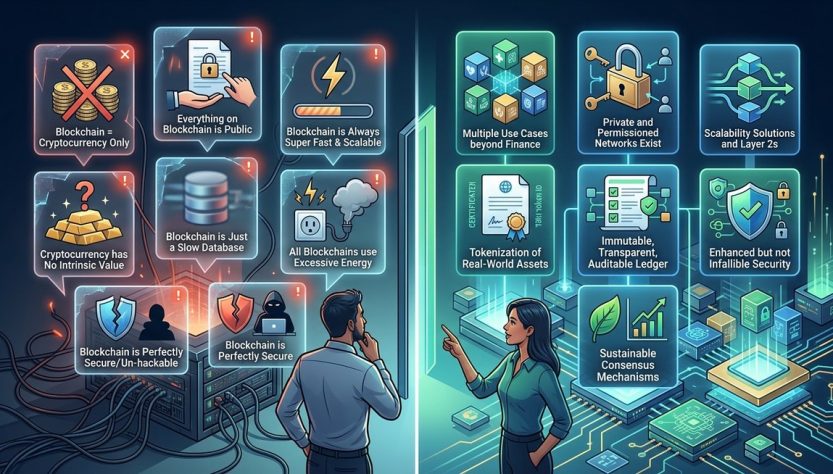
You’ve heard blockchain will change everything. You’ve also heard it’s a scam.
Both camps sound confident. Yet most arguments rest on fundamental misunderstandings about how distributed ledger technology actually works. Even experienced engineers and investors repeat myths that crumble under scrutiny. The problem isn’t lack of intelligence. It’s that blockchain sits at the intersection of cryptography, economics, and distributed systems, making it easy to grasp one piece while missing the bigger picture.
Many blockchain misconceptions stem from conflating Bitcoin with all distributed ledger technology. The reality is more nuanced: blockchain isn’t inherently anonymous, unhackable, or slow. Different architectures serve different purposes. Understanding these distinctions helps professionals make informed decisions about when distributed ledger technology adds genuine value versus when traditional databases suffice for their specific business requirements.
Blockchain and Bitcoin are not interchangeable terms
Bitcoin represents one application built on blockchain technology.
Treating them as synonyms is like saying the internet and email are the same thing. Bitcoin uses a specific blockchain implementation with particular trade-offs: proof-of-work consensus, public accessibility, and pseudonymous transactions. Other blockchains make completely different architectural choices.
Ethereum introduced smart contracts. Hyperledger Fabric offers permissioned networks for enterprises. Ripple optimizes for payment settlement between financial institutions. Each solves different problems with different constraints.
When someone dismisses “blockchain” because Bitcoin’s energy consumption concerns them, they’re missing thousands of alternative implementations. Many enterprise blockchains use proof-of-stake or proof-of-authority consensus mechanisms that consume a fraction of the energy.
The confusion matters because it leads to poor technology decisions. A supply chain manager might reject distributed ledger solutions entirely based on Bitcoin’s limitations, never realizing public vs private blockchains offer fundamentally different characteristics suited to different use cases.
Complete anonymity is a dangerous assumption
Blockchain transactions are pseudonymous, not anonymous.
There’s a critical difference. Pseudonymous means your identity links to an address rather than your legal name. But that address appears in every transaction you make. Anyone can trace the complete history of funds flowing through that address.
Law enforcement agencies regularly track cryptocurrency transactions. They analyze patterns, connect addresses to real-world identities through exchange records, and build comprehensive financial profiles. The blockchain’s transparency actually makes this easier than tracking cash.
Some projects like Monero and Zcash implement privacy features that obscure transaction details. But most blockchains, including Bitcoin and Ethereum, operate as transparent ledgers where every transaction lives permanently in public view.
For businesses, this has serious implications. Do you want competitors seeing your payment patterns? Can you afford customers tracking your profit margins by watching token movements? Privacy-focused blockchain implementations exist, but you need to choose them deliberately.
The permanent, transparent nature of most blockchains means one mistake in handling sensitive data becomes impossible to reverse. Choose your architecture carefully before committing information to a distributed ledger.
Immutability doesn’t equal invulnerability
Calling blockchain “unhackable” sets dangerous expectations.
The data structure itself resists tampering. Changing one block requires recalculating every subsequent block, which becomes computationally prohibitive as the chain grows. This property makes blockchain valuable for audit trails and record-keeping.
But the ecosystem around blockchain contains multiple attack surfaces:
- Smart contract bugs that drain funds
- Compromised private keys that transfer ownership
- 51% attacks on networks with insufficient hash power
- Exchange hacks that steal user deposits
- Social engineering that tricks users into malicious transactions
The DAO hack in 2016 drained $60 million through a smart contract vulnerability. Mt. Gox lost 850,000 Bitcoin to security failures. Poly Network suffered a $600 million exploit in 2021 (later returned). These incidents didn’t break the blockchain itself, but they devastated users nonetheless.
Security requires defense in depth. The blockchain provides one layer. You still need secure key management, audited smart contracts, robust access controls, and educated users. Understanding what happens when you send a transaction helps identify where vulnerabilities might exist in your specific implementation.
Performance limitations depend on design choices
Yes, Bitcoin processes about seven transactions per second.
That’s genuinely slow compared to Visa’s thousands of transactions per second. But treating this as a universal blockchain limitation ignores the engineering trade-offs involved.
Bitcoin prioritizes decentralization and security over speed. Every node validates every transaction. This redundancy creates resilience but limits throughput. Other blockchains make different choices.
| Blockchain Type | Typical TPS | Trade-off |
|---|---|---|
| Public proof-of-work | 7-15 | Maximum decentralization |
| Public proof-of-stake | 1,000-4,000 | Balanced approach |
| Private permissioned | 10,000+ | Controlled participant set |
| Layer-2 solutions | 50,000+ | Move transactions off main chain |
Solana targets 65,000 transactions per second through architectural optimizations. Private blockchains achieve even higher throughput by limiting validators to trusted parties. Layer-2 solutions like Lightning Network handle transactions off-chain, settling periodically to the main blockchain.
The question isn’t whether blockchain is fast enough. It’s whether a specific blockchain architecture meets your performance requirements. A supply chain tracking system checking in products weekly has very different needs than a payment network processing retail transactions.
Technical expertise helps but isn’t mandatory
Blockchain intimidates people with its technical complexity.
Cryptographic hash functions. Merkle trees. Elliptic curve signatures. Byzantine fault tolerance. The terminology sounds like a computer science graduate seminar.
But using blockchain doesn’t require understanding its internals any more than using email requires understanding SMTP protocols. Developers need deeper knowledge. Business decision-makers need to understand capabilities and limitations.
Modern blockchain platforms provide abstraction layers. You can deploy smart contracts using visual programming tools. Enterprise solutions offer APIs that feel like traditional databases. Wallet applications hide key management complexity behind familiar interfaces.
The real barrier isn’t technical knowledge. It’s conceptual understanding. You need to grasp:
- When distributed consensus adds value versus centralized databases
- How different consensus mechanisms affect performance and security
- What immutability means for data governance and compliance
- Where your specific use case benefits from blockchain properties
Many successful blockchain implementations come from teams that partner technical specialists with domain experts. The supply chain manager understands provenance tracking requirements. The blockchain architect translates those into appropriate technical solutions.
Coexistence beats replacement in most scenarios
Blockchain won’t replace traditional databases.
This myth appears in two forms. Enthusiasts claim blockchain will revolutionize everything. Skeptics use the lack of total replacement as evidence of failure. Both miss the point.
Technology adoption rarely works through wholesale replacement. Email didn’t eliminate phone calls. Cloud computing didn’t eliminate on-premises servers. New technologies find niches where their specific properties create value, then expand from there.
Blockchain excels in specific scenarios:
- Multiple parties need shared data without trusting a central authority
- Audit trails must be tamper-evident and verifiable
- Automated execution of agreements reduces coordination costs
- Transparency builds trust in multi-party processes
Traditional databases remain superior when:
- A single organization controls all data access
- Performance requirements exceed blockchain capabilities
- Data needs frequent updates or deletions
- Privacy requires keeping information completely confidential
Most enterprise architectures will use hybrid approaches. Critical transactions that require consensus and auditability go on-chain. High-volume operational data stays in traditional databases. The systems integrate through APIs and middleware.
Singapore’s government demonstrates this pragmatic approach. Their blockchain initiatives target specific use cases like trade documentation and digital identity, while maintaining traditional systems for other functions. This measured adoption based on actual value creation, not hype, produces sustainable results.
Standardization remains a work in progress
Different blockchains don’t automatically talk to each other.
This surprises people familiar with internet protocols. Email works across providers. Websites work across browsers. The internet succeeded partly through standardization that enabled interoperability.
Blockchain technology hasn’t reached that maturity. Each blockchain operates as an isolated network with its own rules, consensus mechanism, and data format. Moving assets from Ethereum to Bitcoin requires exchanges or specialized bridges. Supply chain data on Hyperledger Fabric can’t easily integrate with financial records on Corda.
This fragmentation creates real problems:
- Enterprises must choose platforms before standards emerge
- Switching costs lock organizations into specific technologies
- Siloed networks limit the network effects that create value
- Integration complexity increases development costs
The industry recognizes this challenge. Cross-chain bridges like Polkadot and Cosmos aim to connect different blockchains. Standards bodies work on interoperability protocols. Enterprise consortia coordinate on common frameworks.
But standardization takes time. The internet took decades to develop mature, universal protocols. Blockchain technology is younger and more complex. Organizations adopting distributed ledger technology today must plan for a heterogeneous environment where different systems require custom integration.
Common misconceptions versus practical reality
| Myth | Reality | Business Impact |
|---|---|---|
| Blockchain equals Bitcoin | Bitcoin is one implementation among thousands | Evaluate solutions based on specific features, not Bitcoin’s characteristics |
| Transactions are anonymous | Most blockchains are pseudonymous and traceable | Plan for transparency or choose privacy-focused alternatives |
| The technology is unhackable | The ledger resists tampering but ecosystems have vulnerabilities | Implement comprehensive security, not just blockchain |
| All blockchains are slow | Performance varies enormously by architecture | Match throughput requirements to appropriate platforms |
| Only experts can use it | Technical depth needed varies by role | Focus on conceptual understanding for business decisions |
| It will replace everything | Blockchain complements existing systems | Identify specific use cases where properties add value |
| All blockchains work together | Interoperability remains limited | Plan for integration complexity across platforms |
Making informed decisions about distributed ledger technology
Understanding these myths helps you ask better questions.
When someone proposes a blockchain solution, you can now probe the specifics. Which consensus mechanism? Public or private? What throughput? How does it handle privacy? What happens if we need to delete data for regulatory compliance?
The technology offers genuine advantages for certain applications. Distributed consensus without central authority. Tamper-evident audit trails. Automated execution through smart contracts. Transparency that builds trust among multiple parties.
But those advantages come with trade-offs. Performance limitations. Integration complexity. Governance challenges. Regulatory uncertainty. Learning how distributed ledgers actually work helps you evaluate whether those trade-offs make sense for your situation.
The most successful blockchain implementations start with clear problems, not solutions seeking problems. They identify scenarios where distributed consensus creates measurable value. They choose appropriate architectures for specific requirements. They integrate thoughtfully with existing systems rather than attempting wholesale replacement.
Singapore’s position as a blockchain hub stems partly from this pragmatic approach. Government initiatives, enterprise pilots, and startup innovation all focus on practical value creation rather than hype. The ecosystem supports experimentation while maintaining healthy skepticism about overblown claims.
Separating signal from noise in blockchain discussions
The blockchain conversation suffers from extreme positions.
True believers see distributed ledger technology as the solution to every problem. Skeptics dismiss it entirely as a solution seeking a problem. Both positions oversimplify a complex technology with real capabilities and real limitations.
Your job as a decision-maker isn’t to join either camp. It’s to understand the specific properties blockchain offers, evaluate whether those properties solve actual problems you face, and implement solutions that create measurable value.
That requires moving past myths to examine architectural details. It means asking uncomfortable questions about performance, cost, and complexity. It demands honest assessment of whether distributed consensus actually improves on centralized alternatives for your use case.
The technology continues maturing. Standards will emerge. Interoperability will improve. Performance will increase. New consensus mechanisms will address current limitations. But those improvements won’t make blockchain universally applicable any more than advances in relational databases made them the right choice for every data storage need.
Start with the problem. Understand the technology options. Make informed decisions based on your specific requirements. That’s how you separate blockchain myths from blockchain value.