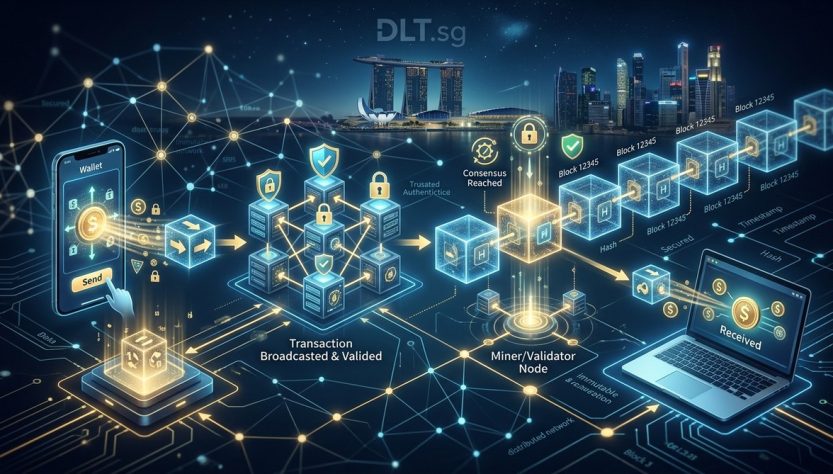
You press send on your wallet app, and within seconds, your cryptocurrency starts moving across the globe. But what actually happens in those moments between clicking a button and seeing the transaction confirmed?
When you send a blockchain transaction, your wallet creates a digitally signed message that broadcasts to thousands of nodes. Miners or validators then verify your transaction, bundle it into a block, and add it to the permanent ledger. The entire process typically takes minutes to hours depending on network conditions and fees paid.
The journey starts in your wallet
Your wallet is not actually storing cryptocurrency. Instead, it holds private keys that prove ownership of funds recorded on the blockchain.
When you decide to send funds, you enter the recipient’s address and the amount. Your wallet software then constructs a transaction message containing this information, plus a reference to where your funds currently exist on the blockchain.
Think of it like writing a check. You specify who gets paid, how much, and you sign it to prove authorization. The signature is what makes the transaction legitimate.
Your wallet uses your private key to create a unique digital signature for this specific transaction. This signature proves you own the funds without revealing your private key to anyone.
The mathematics behind this signature are clever. Anyone can verify the signature matches your public address, but nobody can forge your signature without your private key.
Broadcasting to thousands of computers simultaneously
Once signed, your transaction needs to reach the network. Your wallet connects to one or more nodes, which are computers running blockchain software.
These nodes act as entry points. When your wallet sends the transaction to a node, that node immediately shares it with other nodes it knows about.
Within seconds, your transaction spreads across the entire network through this peer-to-peer gossip protocol. Nodes in Singapore, London, New York, and São Paulo all receive copies almost simultaneously.
Each node that receives your transaction performs basic validation checks:
- Does the signature match the sender’s address?
- Do the referenced funds actually exist?
- Has this transaction already been spent elsewhere?
- Is the transaction formatted correctly?
If any check fails, nodes reject the transaction and stop spreading it. Valid transactions enter what’s called the mempool, a waiting area for unconfirmed transactions.
Life in the mempool waiting room
The mempool is where your transaction sits alongside thousands of others, all waiting to be included in the next block.
Not all transactions are equal in this waiting room. Miners and validators prioritize transactions based on fees. If you paid a higher fee, your transaction moves toward the front of the line.
During busy periods, the mempool can swell to hundreds of thousands of pending transactions. This is why fees spike when networks get congested. Everyone competes for limited block space.
Your transaction might sit in the mempool for seconds or hours, depending on network conditions and the fee you attached. Some wallets let you adjust fees after sending, allowing you to speed up stuck transactions.
While waiting, your transaction remains unconfirmed. The recipient can see it’s coming, but the funds aren’t truly theirs yet. Nothing is final until a block includes the transaction.
Miners and validators select your transaction
Someone needs to decide which transactions from the mempool make it into the next block. This is where miners (in proof-of-work networks) or validators (in proof-of-stake networks) come in.
These network participants are essentially competing for the right to create the next block. They select transactions from the mempool, typically choosing those with the highest fees first.
A miner or validator bundles your transaction with hundreds of others into a candidate block. This block has a maximum size limit, so not every pending transaction can fit.
In proof-of-work systems like Bitcoin, miners then race to solve a computational puzzle. The first to solve it gets to add their block to the chain and collect all the transaction fees.
In proof-of-stake systems like Ethereum, validators are chosen through a selection algorithm. The chosen validator proposes a block, and other validators verify it’s correct.
Either way, once a miner or validator successfully adds a block containing your transaction, you’ve received your first confirmation.
The six-step transaction lifecycle
Here’s exactly what happens when you send blockchain transaction, broken down into discrete stages:
-
Transaction creation: Your wallet constructs a transaction message with sender, recipient, amount, and fee information.
-
Digital signing: Your private key generates a cryptographic signature that proves you authorized this specific transaction.
-
Network broadcast: Your wallet sends the signed transaction to connected nodes, which spread it across the global network.
-
Mempool entry: Nodes validate the transaction and add it to their mempool if all checks pass.
-
Block inclusion: A miner or validator selects your transaction, includes it in a new block, and adds that block to the chain.
-
Confirmation accumulation: Additional blocks build on top of the block containing your transaction, making it increasingly permanent.
Each subsequent block added after yours counts as an additional confirmation. Most services consider a transaction final after three to six confirmations.
Understanding confirmation depth and finality
One confirmation means your transaction is in a block. But that doesn’t guarantee permanence.
Blockchain networks occasionally experience reorganizations where the chain’s tip gets replaced with an alternative version. This can happen due to network delays or, rarely, malicious attacks.
The deeper your transaction sits in the chain, the more secure it becomes. Each new block on top makes reversing your transaction exponentially more difficult.
Different networks and use cases require different confirmation depths:
| Transaction Type | Typical Confirmations | Approximate Wait Time |
|---|---|---|
| Small coffee purchase | 0-1 | Instant to 10 minutes |
| Standard payment | 3-6 | 30 minutes to 1 hour |
| Large exchange deposit | 6-12 | 1 to 2 hours |
| Critical settlement | 20+ | 3+ hours |
For everyday purchases, merchants often accept zero confirmations and rely on other fraud prevention measures. For large amounts, waiting for multiple confirmations is standard practice.
The concept of how distributed ledgers actually work helps explain why multiple confirmations increase security through consensus mechanisms.
What can go wrong during the process
Transactions don’t always proceed smoothly. Several issues can interrupt the journey.
Insufficient fees: If you set fees too low during busy periods, your transaction might sit in the mempool indefinitely. Some networks eventually drop old unconfirmed transactions, returning funds to your wallet.
Double-spend attempts: If you try sending the same funds twice, only one transaction will confirm. The other gets rejected once nodes detect the conflict.
Network congestion: High demand can slow confirmation times from minutes to hours or even days. This is especially common during market volatility when trading activity spikes.
Smart contract failures: On platforms like Ethereum, transactions can fail if they interact with smart contracts that reject them. You still pay gas fees even when transactions fail.
Incorrect addresses: Sending to a wrong or invalid address usually results in permanent loss. Blockchain transactions are irreversible by design.
Always double-check recipient addresses before sending. Most wallets support address book features or QR codes to reduce typing errors. For large amounts, consider sending a small test transaction first.
How different blockchains handle transactions differently
Not all blockchain networks process transactions identically. Each has unique characteristics that affect speed, cost, and finality.
Bitcoin processes blocks roughly every 10 minutes. Transactions are relatively slow but highly secure. The network prioritizes decentralization and immutability over speed.
Ethereum produces blocks every 12 seconds, offering faster initial confirmations. However, gas fees can vary dramatically based on network demand.
Newer networks like Solana or Avalanche process thousands of transactions per second with sub-second finality. They achieve this through different consensus mechanisms and architectural trade-offs.
The choice between public vs private blockchains also affects transaction processing, with private networks often offering faster finality through controlled validator sets.
Layer 2 solutions add another dimension. These networks batch many transactions off-chain, then periodically settle to a main blockchain. Users get fast, cheap transactions while inheriting the security of the underlying chain.
Reading transaction details on block explorers
Block explorers are websites that let you track transactions in real time. They’re like package tracking for blockchain transfers.
Enter your transaction ID (also called a hash), and you’ll see detailed information:
- Current confirmation status
- Timestamp of block inclusion
- Sender and recipient addresses
- Amount transferred and fees paid
- Position within the block
- Current network confirmation depth
These explorers pull data directly from blockchain nodes, giving you an authoritative view of transaction status. Popular explorers include Etherscan for Ethereum, Blockchain.com for Bitcoin, and network-specific tools for other chains.
You can watch your transaction move from unconfirmed to one confirmation to many, all in real time. This visibility is one of blockchain’s core features. Every transaction is publicly auditable.
Transaction fees and priority mechanics
Fees serve two purposes: compensating network participants and preventing spam attacks.
When you send a transaction, you specify how much you’re willing to pay per unit of data or computation. Miners and validators naturally prefer transactions that pay more.
Fee markets are dynamic. During calm periods, you might pay pennies. During network congestion, fees can spike to tens or hundreds of dollars for a single transaction.
Most modern wallets estimate appropriate fees based on current network conditions. They analyze recent blocks to predict what fee level will get your transaction confirmed within a target timeframe.
Some networks implement more sophisticated fee mechanisms. Ethereum’s EIP-1559 introduced a base fee that adjusts automatically based on network demand, plus an optional priority fee for faster inclusion.
Understanding fee dynamics helps you balance cost against urgency. Non-urgent transactions can use lower fees and wait longer. Time-sensitive transfers justify higher fees for faster confirmation.
The role of nodes in transaction propagation
Nodes are the backbone of blockchain networks. These computers maintain copies of the entire transaction history and enforce network rules.
When your transaction broadcasts, it reaches nodes operated by exchanges, mining pools, hobbyists, and businesses. These nodes don’t trust each other, which is the point.
Each node independently verifies every transaction and block. If a node receives invalid data, it rejects it and doesn’t pass it along. This distributed verification is what makes blockchains secure without central authority.
Some nodes are lightweight, only storing recent data. Others are full nodes, maintaining the complete history from the genesis block. Full nodes provide the strongest security guarantees.
Anyone can run a node. You don’t need permission or special hardware for most networks. This openness ensures no single entity can control transaction processing or censor specific transfers.
Common transaction types and their unique paths
Basic value transfers are the simplest transaction type. You send coins from one address to another, and that’s it.
Smart contract interactions are more complex. Your transaction includes code execution instructions. The network runs this code, which might trigger multiple actions: token transfers, state updates, or calls to other contracts.
Multi-signature transactions require approval from multiple parties. Your transaction might be one of several needed signatures. It doesn’t process until all required parties sign.
Atomic swaps let you trade assets across different blockchains without intermediaries. These transactions either complete entirely or fail completely, preventing one party from receiving funds while the other doesn’t.
Each transaction type follows the same basic path through signing, broadcasting, and confirmation. But the validation rules and processing complexity vary significantly.
Why understanding this matters for users
Knowing what happens when you send blockchain transaction helps you make better decisions.
You’ll understand why fees matter and when to pay more for faster service. You’ll recognize that unconfirmed transactions aren’t final and can potentially be replaced or canceled.
You’ll appreciate why exchanges require multiple confirmations before crediting deposits. You’ll know what to check when a transaction seems stuck.
This knowledge also helps you evaluate different blockchain networks. Speed, cost, and security trade-offs become clearer when you understand the underlying mechanics.
Most importantly, you’ll use blockchain technology more confidently. The process might seem complex, but it’s remarkably reliable once you grasp the fundamentals.
From your wallet to permanent record
Every blockchain transaction follows this same fundamental pattern, whether you’re buying coffee or settling international business payments.
Your wallet signs, nodes verify, miners or validators include, and the network confirms. Each step serves a purpose in creating a secure, decentralized payment system.
The next time you send a transaction, you’ll know exactly what’s happening behind that progress bar. You’re participating in a global network of computers working together to process and verify your transfer without any central authority.
That’s the real innovation of blockchain technology. Not just digital money, but a new way of coordinating trust and recording transactions that anyone can verify and no one can unilaterally control.