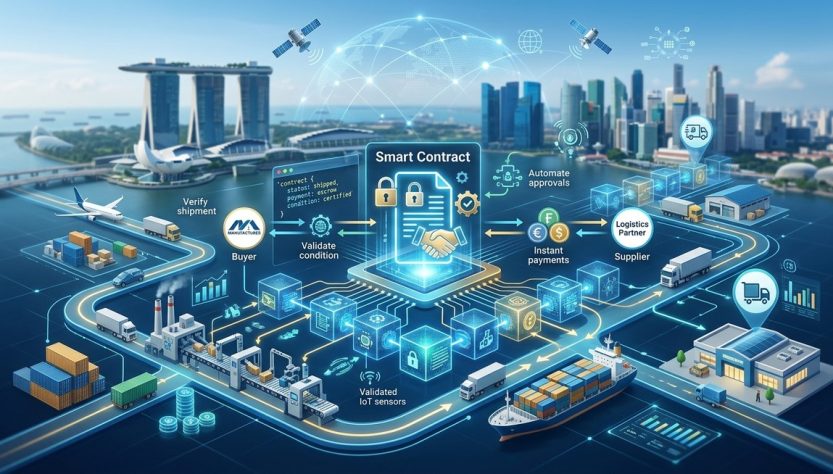
Picture this: a container ship carrying frozen prawns from a Thai farm finally docks at Jurong Port. The temperature sensors show a perfect run, the customs documents clear in minutes, and payment lands with the exporter before the crane lifts the first pallet. No phone tag. No disputed invoices. No one chasing a missing signature.
That scenario is not a distant dream. It is exactly what smart contracts supply chain automation delivers in 2026. And the best part? You do not need to rebuild your entire logistics operation to get there.
Smart contract automation turns supply chain friction into code. By encoding payment terms, compliance checks, and delivery confirmations on a shared ledger, enterprises cut settlement times from weeks to minutes, remove manual reconciliation, and give every partner one trusted version of the truth. Start small, focus on one bottleneck, and scale from there.
Why 2026 Is the Tipping Point for Enterprise Supply Chains
For years, blockchain pilots lived in the lab. Teams built proofs of concept, presented them to leadership, and then struggled to move past the demo stage. That phase is ending. In 2026, the conversation has shifted from “is this real?” to “how fast can we deploy?”
Several forces are pushing this shift. First, Singapore’s Monetary Authority keeps refining its digital asset frameworks, giving enterprises clearer guardrails. Second, the region’s logistics hubs have matured their blockchain consortium models, so partners are no longer experimenting in isolation. Third, the talent pool has deepened. Teams now understand how distributed ledgers actually work, which means fewer surprises during integration.
The result is a market where smart contracts are no longer a novelty. They are becoming the default way to move value and verify trust across trading networks.
What Smart Contracts Actually Do in a Supply Chain
Before we talk about automation, let us be clear on what a smart contract is. Think of it as a set of business rules written in code. Those rules live on a blockchain, and they execute automatically when certain conditions are met. No manager needs to approve the trigger. No clerk needs to update a spreadsheet. The code does the work.
In a supply chain context, those rules can cover a lot of ground:
- Payment release. A contract can hold funds in escrow and release them to a supplier the moment a shipment is confirmed as delivered.
- Compliance checks. Certificates, inspection reports, and customs declarations can be verified automatically before goods move to the next stage.
- Inventory triggers. When stock levels drop below a threshold, a contract can place a replenishment order with a pre-approved vendor.
- Dispute resolution. When a shipment is late or damaged, the contract can apply penalty clauses without anyone filing a claim.
- Document flow. Bills of lading, letters of credit, and insurance certificates can be issued and transferred on-chain, removing the back-and-forth.
The common thread is that smart contracts replace trust in people with trust in code. That does not mean people disappear. It means their time gets spent on exceptions rather than routine checks.
How to Automate a Supply Chain Workflow in Five Steps
If you are ready to move from theory to practice, here is a simple process that works across industries. You can apply it to a single lane, a product line, or an entire supplier network.
-
Map the current handoff points. Walk a single shipment from purchase order to final payment. Note every time a document changes hands, every approval step, and every time someone re-enters data. Those handoffs are your automation candidates.
-
Pick one bottleneck with clear rules. Do not try to automate everything at once. Choose a step with well-defined conditions. A good candidate is often the payment release after delivery confirmation, because the trigger is objective and the value is measurable.
-
Define the trigger data. Smart contracts need reliable inputs. Decide which data points matter, such as GPS location, temperature readings, or a scanned delivery receipt. Then choose how that data reaches the blockchain. This is where oracles and real-world data come into play.
-
Build a small pilot with trusted partners. Invite two or three partners who share your willingness to learn. Use a permissioned ledger or a private network so you control visibility. Set clear success metrics before you deploy.
-
Measure, learn, and expand. Track the pilot against your baseline. Look at settlement time, dispute rates, and the cost of manual processing. If the numbers move in the right direction, expand the pilot to more lanes and more partners.
This approach keeps risk low while building internal confidence. You also create a repeatable template for the next workflow.
The Payoffs You Can Measure in 2026
The business case for smart contract automation is no longer vague. Enterprises are reporting concrete gains across several categories.
Faster settlement cycles
Traditional trade finance can take weeks. A letter of credit involves banks, couriers, and multiple checks. With smart contracts, the logic lives on-chain. Payment can move within minutes of a verified delivery event. That improves cash flow for suppliers and reduces working capital needs for buyers.
Lower administrative costs
Every manual touchpoint costs money. Data entry, invoice matching, and document verification all add up. Smart contracts remove most of that labor. One enterprise DLT study from 2025 found that automated reconciliation reduced back-office costs by more than a third.
Fewer disputes and chargebacks
When everyone looks at the same data, there is less room for argument. A temperature breach is visible to all parties. A late shipment is timestamped. Smart contracts can even apply penalty clauses automatically, which means the relationship stays clean even when things go wrong.
Stronger compliance and audit trails
Regulators increasingly expect enterprises to prove where goods came from and how they were handled. A blockchain record provides that proof in a way that is easy to audit. This is especially relevant for Singapore’s regulatory push around digital assets and for cross-border trade where documentation is complex.
Common Mistakes That Derail Enterprise Pilots
Not every pilot fails because the technology is immature. Most fail because of avoidable mistakes. Here is a table that contrasts the wrong moves with the right ones.
| Mistake | Why It Hurts | The Better Approach |
|---|---|---|
| Automating a process that is already broken | You just make bad workflows faster | Fix the process first, then automate |
| Choosing a public chain without privacy controls | Competitors see sensitive data | Use a permissioned ledger or private blockchain architecture |
| Ignoring data quality | Smart contracts are only as good as their inputs | Invest in sensors, APIs, and data validation |
| Building a custom solution when standards exist | High maintenance and vendor lock-in | Use enterprise frameworks and consortia standards |
| Skipping the legal review | Smart contracts can conflict with existing agreements | Involve counsel early and update terms |
| Going live without a rollback plan | Bugs can freeze funds or block shipments | Design for upgradeability and test thoroughly |
Avoiding these mistakes is not complicated, but it does require discipline. That is why Singapore’s universities are building a deeper talent pipeline for enterprise blockchain work. You need people who understand both the technology and the business context.
How Singapore and Southeast Asia Fit Into the Picture
Singapore is no longer just a financial hub. It has become the natural home for enterprise blockchain pilots that need regulatory clarity, a strong tech workforce, and access to regional markets. The Singapore Blockchain Innovation Hub continues to attract global enterprises that want to test in a controlled environment before scaling across ASEAN.
The city-state’s position is reinforced by its National Blockchain Roadmap, which promotes research, talent development, and cross-border collaboration. For supply chain leaders, this means you can build a pilot in Singapore and expand into Malaysia, Thailand, Vietnam, and beyond with confidence.
What makes Singapore particularly strong is the combination of public sector support and private sector energy. The MAS stablecoin regulations provide a clear path for using regulated digital assets in trade settlement. That clarity is a major advantage for enterprises that want to move beyond internal pilots and start transacting with external partners.
The Technical Choices That Matter in 2026
Smart contract automation is not a single technology. It is a stack of decisions. Here are the ones that matter most for supply chain leaders.
Which ledger should you use?
Most enterprises choose between a permissioned framework like Hyperledger Fabric and a public chain with privacy features. Hyperledger Fabric remains the dominant choice for enterprises that need granular control over who sees what. But public chains are catching up, especially with the rise of zero-knowledge proofs and other privacy tools.
How do you connect to real-world data?
Smart contracts do not magically know that a shipment arrived. They need data from the outside world. This is where oracles come in. A well-designed oracle network can feed temperature readings, GPS coordinates, and customs status into your contract without giving a single party too much power.
What about interoperability?
Your supply chain does not exist in a vacuum. You will likely need to connect with partners who use different systems. Cross-chain interoperability is one of the hottest areas in enterprise blockchain for good reason. It lets you move data and value across networks without forcing everyone onto a single platform.
How do you handle governance?
Smart contracts are code, and code needs oversight. You need to decide who can upgrade the contract, who can pause it in an emergency, and how disputes are resolved. These decisions are often harder than the technology itself. That is why enterprise blockchain governance deserves as much attention as the smart contract code itself.
A Practical Example: Cold Chain Shipping
Let us bring this to life with a concrete example that shows how the pieces fit together.
Imagine a Singapore-based distributor that imports pharmaceutical products from Europe. The current process involves multiple parties: the manufacturer in Germany, the freight forwarder, the airline, the Singapore customs authority, the distributor, and a local bank that handles payment.
Every step creates a handoff. The manufacturer issues a certificate of analysis. The freight forwarder prepares the air waybill. The airline provides a temperature log. The distributor checks everything against the purchase order. The bank verifies the documents before releasing payment.
Now imagine that process running on a smart contract.
- The manufacturer creates a smart contract that represents the purchase order.
- The contract includes the agreed price, the delivery deadline, and the required temperature range.
- Sensors in the shipping container send temperature readings to the contract every few minutes.
- When the goods arrive in Singapore and pass customs, the contract checks the final temperature log.
- If the temperature stayed within range, the contract releases payment to the manufacturer automatically.
- If the temperature breached the limit, the contract triggers a penalty or routes the shipment for inspection.
The entire process runs without a single manual approval. The manufacturer gets paid faster. The distributor gets better pricing because the supplier no longer needs to cover the risk of late payment. And the regulator gets a complete, tamper-proof record of the shipment’s journey.
This is not a hypothetical example. It is the kind of pilot that Southeast Asian enterprises are building right now, and it scales well beyond pharmaceuticals.
What to Read Next
If you are ready to go deeper, there are a few related topics that will help you build a stronger foundation.
- How Distributed Ledgers Actually Work: A Visual Guide for Beginners is a great starting point if you want to understand the underlying technology without the jargon.
- Public vs Private Blockchains: Which Architecture Fits Your Business Needs? will help you decide which type of ledger is right for your pilot.
- How to Build a Decentralized Autonomous Organization with Smart Contracts shows how the same principles apply to organizational governance.
- Why Do Blockchains Need Consensus Mechanisms? explains the security trade-offs you need to understand before choosing a network.
For a broader view, you might also want to explore how Singapore’s universities are building Southeast Asia’s blockchain talent pipeline or why cross-chain bridges are critical for DeFi’s future growth. And if you are still building your business case, do not miss our guide to Singapore’s National Blockchain Roadmap.
Your First Step Toward Automated Supply Chains
You do not need to automate your entire supply chain by Friday. Start with a single lane, a single product, or a single bottleneck. Map the current process, pick one rule that can be encoded, and run a small pilot with a trusted partner.
The technology has never been more accessible. The regulatory environment in Singapore has never been clearer. And the business case has never been stronger. The only thing missing is the decision to begin.
So pick that one handoff point that frustrates you the most. The one where you know the data is sitting in someone’s inbox. The one where a small delay costs you real money. And ask yourself: what would it take to turn that step into a line of code? That question is the start of your 2026 automation journey.