
Smart contracts aren’t magic, but they do execute code in one of the most unusual computing environments ever built. Unlike traditional programs running on a single server, Ethereum smart contracts run on thousands of machines simultaneously, each verifying the same computation and arriving at identical results. This distributed execution model creates unique constraints and opportunities that shape how developers write, deploy, and interact with code on the blockchain.
Smart contracts on Ethereum are programs compiled into bytecode and executed by the Ethereum Virtual Machine across thousands of nodes. Each operation consumes gas, a resource metering system that prevents infinite loops and spam. Contracts interact through message calls, modify persistent storage, and emit events, all while maintaining deterministic execution to ensure every node reaches consensus on the final state.
Understanding the Ethereum Virtual Machine
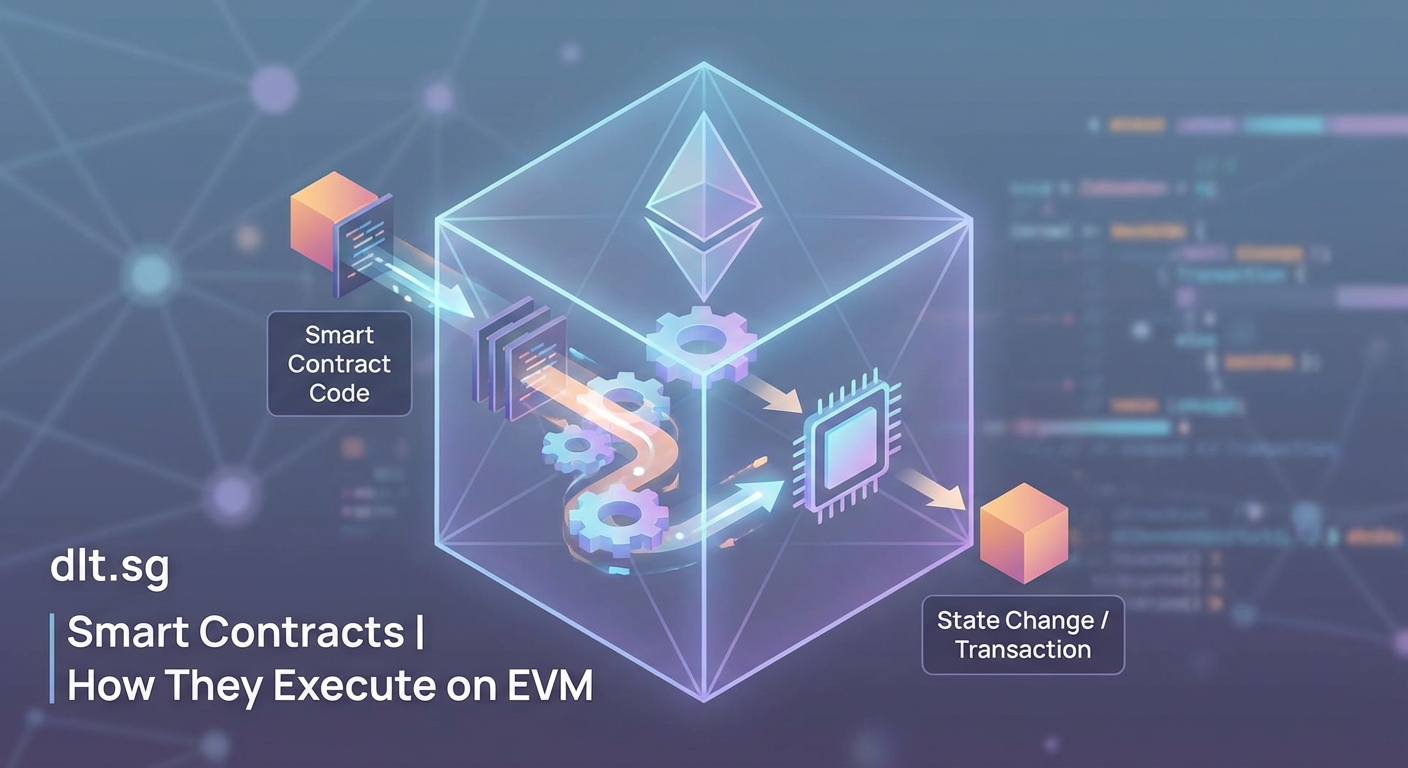
The Ethereum Virtual Machine sits at the heart of how smart contracts work on Ethereum. Think of it as a global computer that exists across every full node in the network. When you deploy a contract or call a function, you’re not running code on a single machine. You’re broadcasting instructions that thousands of nodes will independently execute.
The EVM operates as a stack-based machine. It processes 256-bit words and maintains several data storage areas: the stack itself, memory, and persistent storage. This architecture differs significantly from the register-based processors in your laptop or phone.
Each EVM instruction, called an opcode, performs a specific operation. ADD combines two numbers. SSTORE writes to permanent storage. CALL invokes another contract. These low-level operations form the building blocks of every smart contract function.
What makes the EVM special is its deterministic nature. Given identical inputs and starting state, every node must produce exactly the same output. No randomness. No timestamps from the local system. No reading from external APIs directly. This determinism ensures that distributed ledgers can maintain consensus without trusting any single party.
From Solidity to Bytecode
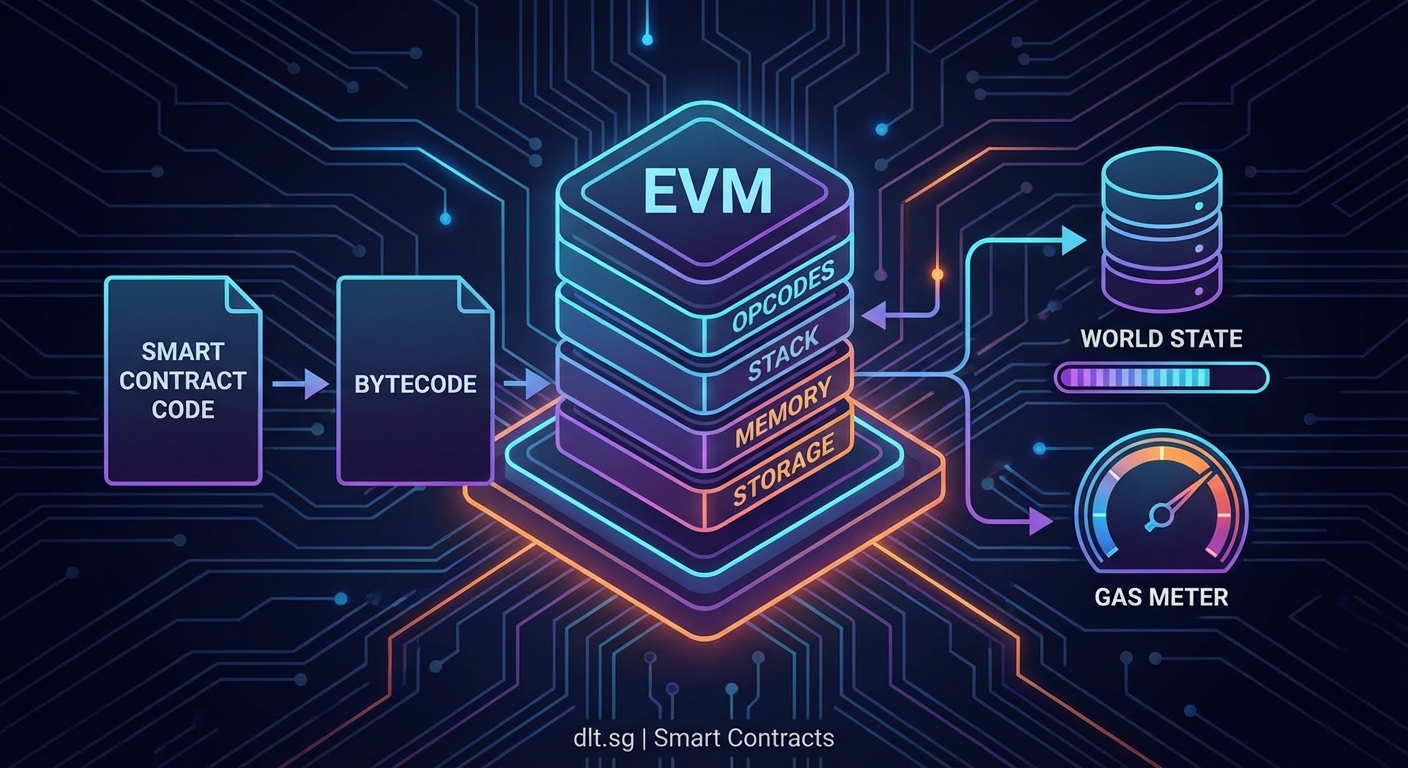
Developers rarely write EVM bytecode directly. Instead, they use higher-level languages like Solidity or Vyper. These languages compile down to the bytecode that the EVM actually executes.
Here’s what happens during compilation:
- The compiler parses your Solidity code and builds an abstract syntax tree
- It performs type checking and validates contract logic
- The optimizer analyzes the code to reduce gas costs
- Finally, it generates EVM bytecode and an Application Binary Interface (ABI)
The bytecode is what gets stored on the blockchain. The ABI is a JSON description that tells external applications how to interact with your contract. It specifies function names, parameter types, and return values.
When you deploy a contract, you submit a transaction containing the bytecode. The EVM executes this bytecode in a special creation context. The code runs once and returns the runtime bytecode, which gets stored at a new contract address.
That stored bytecode is immutable. You can’t patch it or update it like traditional software. This permanence creates both security benefits and challenges. Bugs live forever unless you build upgrade mechanisms into your contract design.
Gas and Resource Metering
Every operation on the EVM costs gas. This isn’t just an arbitrary fee structure. Gas solves a fundamental computer science problem: the halting problem.
Without gas, someone could deploy a contract with an infinite loop. Every node would get stuck trying to execute it, grinding the network to a halt. Gas creates economic incentives that make such attacks prohibitively expensive.
Different operations cost different amounts of gas:
- Simple arithmetic operations cost 3 gas
- Reading from storage costs 200 to 2100 gas depending on access patterns
- Writing to storage costs 5000 to 20000 gas
- Creating a new contract costs 32000 gas plus deployment code execution
Storage operations are deliberately expensive. The EVM design pushes developers to minimize state changes and use storage efficiently. Every byte you write to the blockchain must be stored by every full node forever.
When you submit a transaction, you specify a gas limit and a gas price. The limit caps how much computation you’re willing to pay for. The price determines how much ETH you’ll pay per unit of gas. Miners or validators prioritize transactions with higher gas prices.
If your transaction runs out of gas mid-execution, all state changes revert. You still pay for the gas consumed up to that point. This prevents attackers from getting free computation by submitting transactions that deliberately fail.
Contract Storage and Memory
The EVM provides three places to store data, each with different characteristics and costs.
Storage is persistent. It survives between function calls and transactions. Think of it as a massive key-value database where both keys and values are 256-bit words. Reading from storage costs gas. Writing costs even more. Storage is where you keep balances, ownership records, and other state that must persist.
Memory is temporary. It exists only during a single transaction execution. Memory is byte-addressable and expands dynamically as needed. It costs gas to expand memory, but reading and writing to already-allocated memory is relatively cheap. Developers use memory for temporary calculations and to pass data between internal function calls.
The stack holds the working data for EVM operations. It’s limited to 1024 elements, each 256 bits. Operations pop values from the stack, perform calculations, and push results back. The stack is the fastest and cheapest data location, but its limited depth constrains how deeply you can nest function calls.
Understanding these storage locations matters for optimization. A common pattern is to read from storage once into memory, perform multiple operations on the memory copy, then write the final result back to storage. This minimizes expensive storage operations.
Message Calls and Contract Interaction
Smart contracts don’t run in isolation. They call other contracts, transfer ETH, and compose into complex systems. These interactions happen through message calls.
When contract A calls contract B, the EVM creates a new execution context. Contract B executes with its own memory and stack, but it can read and modify its own storage. If B calls C, another context gets created. This continues up to a depth limit of 1024 calls.
Each message call can include ETH value. The EVM automatically transfers this value before executing the called code. If the call fails or reverts, the value transfer also reverts.
There are several types of calls with different security properties:
| Call Type | Modifies State | Delegates Context | Use Case |
|---|---|---|---|
| CALL | Yes | No | Standard contract interaction |
| STATICCALL | No | No | Read-only view functions |
| DELEGATECALL | Yes | Yes | Library code and proxy patterns |
| CALLCODE | Yes | Partial | Deprecated, avoid using |
DELEGATECALL deserves special attention. When A uses DELEGATECALL to invoke B’s code, that code executes in A’s context. It modifies A’s storage, not B’s. This enables powerful proxy patterns where you separate contract logic from data storage.
Understanding what happens when you send a blockchain transaction helps clarify how these message calls propagate through the network and get included in blocks.
Events and Logging
Smart contracts can emit events. These aren’t stored in the blockchain state, but they do appear in transaction receipts. Events provide a way for contracts to communicate with the outside world.
The EVM includes LOG0 through LOG4 opcodes. Each logs data along with zero to four indexed topics. Topics enable efficient filtering. You might index a token transfer event by sender address and recipient address, letting wallets efficiently find all transfers involving a specific user.
Events cost gas, but less than storage. The data goes into transaction logs, which nodes can discard after processing if they’re not running an archive node. Applications listen for events to update their user interfaces or trigger off-chain processes.
Here’s a practical example. A decentralized exchange emits a Trade event every time someone swaps tokens. Off-chain indexers listen for these events and build a database of historical trades. Users can then query this database for charts and statistics without scanning the entire blockchain.
Deterministic Execution Constraints
The requirement for deterministic execution creates unusual constraints. Your contract can’t generate random numbers using traditional methods. It can’t read the current timestamp with millisecond precision. It can’t make HTTP requests to external APIs.
These limitations stem from a simple requirement: every node must produce identical results. If your contract called Math.random(), different nodes would get different values and fail to reach consensus.
Developers work around these constraints through various patterns:
- Random numbers come from block hashes or oracle services like Chainlink VRF
- Time-dependent logic uses block timestamps, which have ~15 second granularity
- External data enters through oracles that post signed attestations on-chain
The determinism requirement also affects how you think about testing. Traditional unit tests that mock time or randomness won’t accurately reflect on-chain behavior. You need to test against actual block timestamps and verifiable randomness sources.
State Transitions and Transaction Execution
Every transaction triggers a state transition. The EVM starts with the current world state, executes your transaction, and produces a new state. Blockchain nodes verify that this transition follows the protocol rules.
The execution process follows these steps:
- Validate the transaction signature and nonce
- Deduct the gas limit times gas price from the sender’s balance
- Execute the transaction code in the EVM
- Calculate gas used and refund any unused gas
- Add transaction fees to the block beneficiary
- Update the state root to reflect all changes
If any step fails, the entire transaction reverts. The sender still pays gas for the computation performed before the failure. This all-or-nothing approach prevents partial state updates that could leave contracts in inconsistent states.
The state root is a cryptographic hash of the entire world state. It’s included in every block header. This single 32-byte value commits to every account balance, every contract’s storage, and every byte of code across the entire network.
Common Execution Patterns and Antipatterns
Experienced developers recognize patterns that work well on the EVM and antipatterns that waste gas or create security risks.
Batch operations save gas by amortizing the base transaction cost across multiple actions. Instead of sending 100 separate transactions to distribute tokens, write a function that loops through recipients in a single transaction.
Storage packing reduces costs by fitting multiple values into a single 256-bit storage slot. If you have three uint64 values, pack them together instead of using three separate slots.
Event indexing enables efficient off-chain queries. Index the fields that applications will filter by, but remember that each indexed field costs more gas.
Reentrancy guards prevent a common attack pattern where a malicious contract calls back into your contract before the first call completes. The checks-effects-interactions pattern helps: check conditions, update state, then interact with external contracts.
Here are mistakes that even experienced developers make:
- Storing large arrays on-chain instead of using IPFS or other off-chain storage
- Not accounting for gas price volatility when setting transaction gas limits
- Assuming block timestamps are precise or manipulation-resistant
- Using tx.origin for authentication instead of msg.sender
- Forgetting that DELEGATECALL preserves the calling context
The EVM’s constraints aren’t bugs. They’re features that enable thousands of untrusted nodes to execute code and reach consensus. Design with these constraints, not against them.
How Public and Private Networks Differ
The mechanics described above apply to Ethereum mainnet, but the EVM also runs on test networks, Layer 2 solutions, and private chains. The execution model remains the same, but the operational characteristics change.
Public blockchains like Ethereum mainnet prioritize decentralization and censorship resistance. Gas prices fluctuate with network demand. Block times vary slightly. Your transaction might wait in the mempool during congestion.
Private networks often modify these parameters. They might reduce block times to one second for faster finality. They might eliminate gas costs entirely for internal applications. Some use proof-of-authority consensus instead of proof-of-stake.
Layer 2 solutions like Arbitrum and Optimism run EVM-compatible environments with lower fees and higher throughput. They batch transactions and post compressed data to mainnet, inheriting Ethereum’s security while improving scalability.
The bytecode you compile for mainnet works on these alternative networks without modification. This EVM compatibility creates a large ecosystem of tools, libraries, and developer knowledge that transfers across chains.
Why Smart Contract Architecture Matters
The technical details of EVM execution directly impact how you architect applications. Gas costs influence data structure choices. Determinism requirements affect how you handle randomness and time. The immutability of deployed code shapes your upgrade strategy.
Consider a token contract. You could store each user’s balance in a separate storage slot, but that would cost 20,000 gas per new user. Instead, you use a mapping that only allocates storage for addresses that actually hold tokens. This single architectural decision can reduce deployment costs by orders of magnitude.
Or consider a voting system. You might initially design it to store every vote on-chain. But with thousands of voters, storage costs become prohibitive. A better approach stores only the vote tallies on-chain and uses events to create an auditable record. Off-chain indexers can reconstruct the full voting history from these events.
These aren’t just optimization tricks. They’re fundamental to building economically viable applications on Ethereum. Understanding how the EVM executes code lets you make informed tradeoffs between decentralization, cost, and functionality.
The execution model also creates security considerations. Reentrancy attacks exploit the way message calls create new execution contexts. Integer overflow bugs stem from the EVM’s 256-bit word size and lack of built-in overflow protection (before Solidity 0.8.0). Front-running attacks leverage the public nature of the mempool where pending transactions sit before execution.
Making Sense of the Machine
Smart contracts on Ethereum run in an environment unlike any other computing platform. The EVM’s stack-based architecture, gas metering system, and deterministic execution requirements create unique constraints and opportunities.
Every function call, every storage write, every event emission happens across thousands of nodes simultaneously. They all execute the same bytecode, consume the same gas, and arrive at the same final state. This coordination without central authority is what makes blockchain technology transformative.
For developers, understanding these execution mechanics isn’t optional. It’s the foundation for writing efficient, secure, and economically viable smart contracts. The patterns and antipatterns described here represent years of collective learning from the Ethereum community.
Start small. Deploy a simple contract on a test network. Watch how gas costs accumulate. Experiment with different storage patterns. Call contracts from other contracts. Emit events and listen for them. The EVM reveals its logic through hands-on experimentation far better than through documentation alone.
The machine is complex, but it’s also remarkably elegant. Once you grasp how bytecode executes, how gas meters resources, and how state transitions occur, you’ll see why Ethereum has become the foundation for thousands of decentralized applications. That understanding transforms you from someone who uses smart contracts into someone who can build them effectively.
Leave a Reply